
How to Build the Business Case for Finance Automation: A Step-by-Step Guide for Australian CFOs
Ordron30 min read
Most finance leaders already know automation saves time. They have seen the demos, read the case studies, and quietly run the numbers on a spreadsheet at 9 pm on a Tuesday. The conviction is there. What is missing is the sign-off.
Research from Gartner consistently shows that more than 60% of finance automation proposals stall before reaching full approval. The problem is rarely the technology and rarely the economics. The problem is the business case itself. A CFO who presents a vague projection of "efficiency gains" to a board that is worried about system risk, change management, and vendor lock-in is not going to win the argument, no matter how good the underlying opportunity is.
This guide is built for Australian CFOs, finance directors, and senior finance managers who know the ROI exists and need a structured, credible path to getting it approved. Each step is grounded in how automation proposals actually succeed, not how vendors wish they did. The frameworks here are the same ones we use at Ordron when helping finance teams make the case internally, and every example is drawn from work we have shipped with real numbers attached.
Key Takeaways
- Map your stakeholders before you write a single slide. The board's objections are predictable, and your case must pre-empt them.
- Quantify the cost of inaction, not just the benefit of action. Boards approve spending when doing nothing looks more expensive than moving forward.
- Build your financial model around direct, measurable savings first. Indirect benefits are real, but leading with them invites scepticism.
- Structure the proposal around a phased roadmap, not a big-bang deployment. Phasing reduces perceived risk and gives the board an off-ramp if needed.
- Present proof, not projections. Post-go-live, measured results from comparable organisations are worth ten times more than vendor ROI calculators.
- Address security, change management, and vendor lock-in head-on. Leaving these to questions invites a deferral.
Summary Table
| Business Case Component | What to Include | Common Mistake |
|---|---|---|
| Current State Audit | Time spent per process, error rates, headcount involved, tool inventory | Estimating instead of measuring; using annual figures that obscure monthly pain |
| Cost of Inaction | Cost of errors, compliance risk, staff turnover from manual work, opportunity cost of slow close | Framing inaction as neutral; ignoring compounding cost over 12-36 months |
| Stakeholder Map | Decision-makers, influencers, blockers, and their primary concern for each | Pitching to the CFO only; missing IT, operations, or the CEO's risk lens |
| Financial Model | Direct savings (FTE time, error correction), indirect savings (faster close, better data), payback period | Using aspirational projections rather than benchmarks from comparable post-go-live engagements |
| Phased Roadmap | Phase 1 quick wins, Phase 2 core automation, Phase 3 advanced capability; timeline, cost, and owner per phase | Presenting a single monolithic deployment that feels impossible to reverse |
| Proof and Evidence | Post-go-live case studies, pilot results, vendor references in your industry or size range | Relying on vendor-supplied ROI calculators; no real-world comparator |
| Objection Handling | Security posture, change management plan, data ownership, exit provisions in vendor contract | Leaving objections to Q&A; arriving unprepared on any of these four topics |
Why Most Finance Automation Proposals Get Rejected
Before walking through the steps, it is worth being direct about why proposals fail. Having reviewed a significant number of failed pitches from finance teams across Australia, the causes cluster into four patterns.
The case is built on vendor projections. A software vendor's ROI calculator is designed to sell software, not to survive board scrutiny. When a CFO presents numbers sourced from a vendor calculator with no validation against the organisation's own data, any commercially literate board member will notice. The proposal loses credibility before the financial model is even challenged.
The savings are framed as headcount reduction. Telling the board that automation will replace two full-time staff might be accurate, but it creates an immediate political problem. The people those staff report to are often in the room. Finance leaders who lead with headcount reduction face resistance from peers who are now worried about their own teams. The smarter frame is hours returned to higher-value work, which is both more accurate and far less threatening.
The risk section is thin. Boards are not primarily optimising for upside. They are managing downside. A business case that spends four slides on benefits and half a bullet point on risk signals to the board that the proponent has not thought carefully about what could go wrong. Objections on security, change management, and vendor lock-in are entirely predictable. Arriving without prepared answers to all three is avoidable.
The scope is too large. A proposal to automate the entire finance function in a single programme is a large capital commitment with a long payback period and significant execution risk. Boards with any memory of failed ERP implementations will default to caution. A phased approach that delivers measurable results in 90 days, then expands, is a fundamentally different risk profile and a much easier approval.
Step 1: Audit Your Current State and Quantify the Pain
You cannot build a credible business case without a credible baseline. Before any modelling, any slides, or any stakeholder conversations, you need to know exactly what your finance team is doing manually, how long it takes, and what it costs.
This is not an exercise in broad estimation. It is a process-level time study. Walk through each finance process that is a candidate for automation, accounts payable, accounts receivable, bank reconciliation, month-end close, management reporting, and map the steps that are performed manually. For each step, record who does it, how long it takes per occurrence, how many times it occurs per month, and what the error rate is.
The numbers you are building toward are: total manual hours per month per process, total annual cost of that manual labour at a fully loaded rate, and the frequency and cost of errors that manual work introduces.
For a practical starting point, Ordron's finance health check walks finance teams through this diagnostic in a structured way. It surfaces the specific processes where automation will deliver the fastest return, which is exactly the data you need before building the financial model.
One trap to avoid here is using annual figures in your baseline. Annual numbers are psychologically comfortable because they are big enough to feel significant. But boards process risk and investment at a monthly and quarterly cadence. Showing that your AP team spends 320 hours per month on manual data entry is more viscerally compelling than saying 3,840 hours per year, even though the maths is identical. Ground your baseline in the monthly operating reality.
When I worked with a family-owned logistics operator running a twenty-year-old ERP alongside Xero, the audit revealed that finance staff were manually re-entering data between the two systems, consuming more than 160 hours per month in duplicate entry and reconciliation work alone. That single number, 160 hours, became the anchor for the entire business case. It was specific, it was measured, and it was impossible to dismiss. We built an RPA bot that drove the legacy ERP interface directly, validated data against a SQL layer, and synced clean records into Xero and live reporting dashboards, leaving the existing ERP completely intact. Those 160 hours came back every month. No ERP replacement, no disruption to existing operations. The business case succeeded because the baseline was unambiguous.
Step 2: Calculate the Cost of Inaction
The most underused lever in any finance automation proposal is the cost of doing nothing. Most business cases are structured as an argument for why automation is worth the investment. A stronger structure frames the question as: what does it cost us to stay where we are?
This reframe works because it changes the decision from "should we spend money?" to "which option is more expensive?" When inaction has a measurable price tag, the board is no longer weighing a known cost (the automation investment) against an uncertain benefit. They are weighing two known costs against each other.
The cost of inaction has several components that are worth quantifying separately.
Direct labour cost. If your finance team spends 320 hours per month on manual processes, and those staff are charged out at an average fully loaded cost of $75 per hour (a conservative figure for an experienced finance officer in Australia in 2026), that is $24,000 per month, or $288,000 per year, in labour applied to work that automation could handle. This number is already in your current budget. You are already paying it.
Error and rework cost. Manual data entry produces errors. Those errors require reconciliation time, correction workflows, and sometimes external audit fees to resolve. In AP alone, industry benchmarks suggest that error rates on manually coded invoices run between 1% and 3%. For an organisation processing 2,000 invoices per month, that is between 20 and 60 errors per month. Each error requires staff time to identify, investigate, and correct. Quantify this cost and include it in the baseline.
Compliance and regulatory risk. Australian organisations operating under ATO reporting obligations, the Australian Consumer Law, or sector-specific regulations face real exposure when finance data is inaccurate or delayed. Late BAS lodgements attract penalties. Incorrect GST coding creates audit risk. The ACCC has signalled ongoing scrutiny of financial reporting accuracy across a range of sectors. These are not theoretical risks. Put a conservative dollar figure on the exposure.
Opportunity cost. This is the hardest component to quantify, but it is often the most persuasive for a growth-oriented board. When your finance team spends the majority of their month on data entry and reconciliation, they are not spending it on financial analysis, scenario modelling, or the kind of commercial insight that drives decisions. What decisions have been made slowly, or not made at all, because the finance function was too busy to provide the analysis? What is that worth?
Ordron's cost of inaction calculator is built specifically to help finance teams put a number on this. It is worth running your own figures through it before you present to the board.
Step 3: Map Stakeholders and Their Concerns
A finance automation proposal does not succeed on numbers alone. It succeeds when the right people are convinced of the right things before the formal presentation. Stakeholder mapping is not a soft skill add-on. It is the difference between a proposal that gets approved and one that gets deferred for another quarter.
Start by identifying every person who has a vote, a veto, or meaningful influence over the decision. In most Australian mid-market and enterprise organisations, this list includes the CEO, the board (or relevant board committee), the CTO or head of IT, the COO or head of operations, and the finance team's own direct reports. In some organisations, HR has a voice when headcount implications are part of the proposal.
For each stakeholder, identify their primary concern. This is not what you think they care about. It is what they have actually said, in meetings, in past budget discussions, in their responses to previous technology investments. Common patterns include:
- CEO: Return on investment, competitive positioning, and strategic alignment. Wants to know this moves the business forward, not just saves money in finance.
- Board: Risk, governance, and downside protection. Particularly sensitive to technology project failures and any implication of reduced control over financial data.
- CTO/IT: Integration complexity, security posture, vendor management overhead, and whether this creates more technical debt or reduces it.
- COO: Disruption to operations, change management burden, and whether the finance team's improved throughput actually helps operational teams.
- Finance team: Whether this makes their working day better or worse, whether their jobs are at risk, and whether the new process is actually reliable.
Once you know what each stakeholder cares about, you can brief them individually before the formal presentation. The goal of these conversations is not to pre-sell the proposal. It is to surface objections early, incorporate legitimate concerns into the design, and ensure that no stakeholder hears something for the first time in the boardroom that makes them feel blindsided.
The stakeholders who kill automation proposals most reliably are the ones who were not consulted until they were asked to vote. Do not make that mistake.
Step 4: Build the Financial Model
The financial model is the engine of your business case. It needs to be credible, conservative, and structured around numbers that your organisation has actually measured, not numbers a vendor supplied.
For a detailed treatment of the metrics that go into an automation ROI calculation, including FTE cost savings, error reduction value, and payback period methodology, the finance automation ROI calculator guide covers the mechanics in depth. What follows here is the structure for presenting those numbers in a board-ready business case.
Direct savings are the foundation. These are savings that flow directly from reducing manual labour. Calculate them as: (hours per month eliminated) x (fully loaded hourly cost) x 12. Use your own HR data for the fully loaded rate, which should include salary, superannuation at the current 11.5% rate, leave entitlements, and any applicable on-costs. Do not use vendor benchmarks for this number. Your board will ask where it came from.
Indirect savings are real but secondary. They include faster month-end close (which has a quantifiable value in terms of decision-making speed), reduced audit fees where automation produces cleaner records, and lower error correction costs. Include these in the model but present them separately from direct savings, clearly labelled as indirect. Mixing the two invites the question of whether your numbers are inflated.
Implementation cost needs to be presented completely. Include licensing or subscription costs, implementation fees, internal staff time for the project, training, and a contingency of at least 15% for scope changes. Understating implementation cost is one of the fastest ways to lose board trust permanently.
Payback period is the figure most boards focus on. Calculate it as total implementation cost divided by monthly net saving. A payback period of under 12 months is achievable for well-scoped AP automation in most Australian mid-market organisations. A payback period of 18-24 months is still compelling for more complex programmes. Anything beyond 36 months will face serious scrutiny.
The numbers I reference here are not aspirational. Across Ordron's book of work, the top manual work reduction we have measured is 85%, across engagements spanning 8 industries and 17 case studies. Our AP deployments using intelligent document understanding have achieved coding accuracy above 95% and auto-processing rates of 75% or higher for supplier invoices. AR reconciliation time for a Xero-based freight operator we worked with fell by 80%. These are measured after go-live. They are the kind of benchmarks that make a financial model credible, because they come with a challenge, an intervention, and a measured result. No aspirational projections.
One important distinction: this guide is about structuring the business case and presenting the financial model. The mechanics of calculating specific ROI metrics, including which KPIs to track and how to weight them, are covered in detail in the ROI calculator article. Use both together.
Step 5: Structure a Phased Implementation Roadmap
One of the single most effective changes you can make to a finance automation business case is replacing a single deployment proposal with a phased roadmap. Phasing does not reduce the ambition of the programme. It structures it in a way that reduces perceived risk, delivers early proof, and gives the board a series of smaller decisions rather than one large one.
A well-designed phased roadmap for Australian mid-market finance automation typically looks like this:
Phase 1: Quick Wins (Months 1-3). Select one or two high-volume, well-defined processes where the current manual burden is clear and the automation path is straightforward. AP invoice capture and coding is the most common starting point. Accounts receivable reconciliation is another. The goal of Phase 1 is not to transform the finance function. It is to deliver a measured result that proves the approach works inside your specific environment.
When I worked with a national logistics provider processing AP across multiple depots through a SharePoint-based workflow, each batch of invoices was taking four hours to move through capture, coding, and filing, with staff handling every step manually. We plugged OCR and workflow logic directly into the existing SharePoint process, automating document capture, GL coding, and filing without introducing any new software into the stack. AP cycle time dropped from four hours to fifteen minutes per batch. That Phase 1 result became the foundation for a broader programme. The board approved it because we showed them a measured outcome, not a projection.
Phase 2: Core Automation (Months 4-9). With Phase 1 results in hand, expand to the broader set of processes identified in the current state audit. This typically includes bank reconciliation, supplier statement matching, intercompany transactions, and automated reporting. At this stage, integration complexity increases and the intelligent document understanding layer becomes more important, particularly for organisations processing diverse supplier invoice formats.
Phase 3: Advanced Capability (Months 10-18). This phase addresses more complex automation, including exception management workflows, predictive cash flow modelling, automated management reporting packs, and advanced analytics. It is also the phase where organisations begin realising the strategic value of automation, shifting finance team capacity from data processing to commercial analysis.
Presenting this roadmap gives the board a clear picture of what they are approving in Phase 1 (a contained, lower-risk investment with a 90-day proof point) versus the full programme. Most boards are more comfortable approving Phase 1 immediately and reviewing Phase 2 after Phase 1 delivers. Design the proposal to allow for that decision.
Also be explicit about the approach to existing systems. One of the most persistent myths in finance automation is that meaningful transformation requires replacing legacy platforms. It does not. The better approach, in the overwhelming majority of cases, is to build a bridge around existing infrastructure. Most finance teams already have the data they need. The problem is that it is trapped in incompatible tools, manual steps, and spreadsheet exports. Replacing a working ERP introduces risk, cost, and disruption that the automation savings rarely justify in the near term. The logistics operator I mentioned earlier recovered 160 hours per month without touching their twenty-year-old ERP at all. Build a bridge, not a replacement. Make that explicit in your roadmap.
For accounts payable specifically, the AP automation implementation guide covers the technical and process design considerations that should inform your Phase 1 scope.
Step 6: Present With Proof, Not Projections
The single most persuasive element of any finance automation business case is not the financial model. It is evidence from comparable organisations that have already done it and measured the results.
Boards evaluate business cases through a risk lens. A well-constructed financial model demonstrates that you have done the analysis. Proof from comparable organisations demonstrates that the analysis is grounded in reality. These are different things and both matter.
The most useful proof comes from organisations that are similar to yours in size, industry, and technical environment. A case study from a ASX 50 enterprise is not particularly persuasive to the board of a mid-market logistics company. A case study from a comparable logistics operator, showing specific numbers on a specific process, is.
Ordron's case studies are structured exactly this way. Each one documents the specific challenge, the exact automation shipped, and the measured outcome after go-live. No projected savings. No vendor benchmarks. Numbers that were measured after the work was live.
For board presentations specifically, the case study proof pack is a downloadable set of real-world examples formatted for presentation. It is worth having these as supporting material rather than trying to summarise case studies verbally in the room.
When you present proof, do three things. First, anchor the comparator to your organisation: "This is a logistics company of similar size and complexity to us, running a comparable AP process." Second, present the specific numbers: not "significant time savings" but "AP cycle time from four hours to fifteen minutes per batch." Third, connect the proof to your own baseline: "Our current AP cycle is similar. Based on our volume, the same improvement would recover approximately X hours per month, at a cost of $Y."
This structure moves the board from evaluating a projection to evaluating whether your situation is comparable to a proven outcome. That is a much easier decision.
If you have the opportunity to run a pilot before the full business case presentation, do it. A pilot on a single process, even a small one, gives you post-go-live data from your own environment. That is the highest-quality proof available and it eliminates the comparability question entirely.
Step 7: Address Board Objections Directly
The board will have objections. The three most common, and the most proposal-killing if handled poorly, are security, change management, and vendor lock-in. Address each one explicitly in the proposal. Do not leave them for Q&A.
Security. Finance data is among the most sensitive data an organisation holds. Any proposal to introduce automation into finance workflows will trigger questions about data access, storage, and breach exposure. Your response needs to cover: where data is processed and stored (on-premise vs cloud, Australian data residency where relevant), access controls and audit logging, how the automation layer handles credentials and API keys, and what the incident response process looks like if something goes wrong. If you are working with an automation partner, ask them to provide a written security posture statement that you can include as an appendix.
For Australian organisations, data sovereignty is increasingly relevant. The Australian Privacy Act 1988 and the Australian Government's data residency guidelines apply to many mid-market and enterprise finance teams. If your automation touches personally identifiable information in any form, you need to address this explicitly.
Change management. Finance automation changes how people work. The board knows this and will want to see a credible plan for managing that change. Your response should cover: how the finance team was involved in scoping the automation (top-down mandates fail; bottom-up design succeeds), what training and transition support is provided, how the team's role evolves from data processing to analysis, and what the timeline and communication plan looks like for the go-live period.
Be direct about the headcount question if it comes up. The honest answer in most finance automation programmes is not that jobs are eliminated. It is that the same headcount becomes significantly more productive and is redirected to work that has more commercial value. In a tight labour market, that is a compelling retention argument as much as a cost argument.
Vendor lock-in. Boards that have been through an ERP implementation gone wrong are acutely sensitive to vendor dependency. Your response needs to cover: what happens to your data if you end the relationship with the automation vendor, whether the automation is built on proprietary tools or on open standards, what the exit provisions in the contract look like, and whether your internal team can maintain and extend the automation over time.
At Ordron, we are explicit with clients that the work we ship is designed to sit on top of their existing infrastructure, not to replace it. The data stays in the client's environment. The automation layer can be maintained by the client's internal team or IT vendor if they choose to move on. That is a specific, defensible answer to the lock-in question. Whatever your situation is, have a specific answer ready.
Bringing It All Together: The Proposal Structure
Once you have completed all six steps above, the formal proposal document should follow a structure that mirrors how boards make decisions: problem first, cost of inaction second, solution third, proof fourth, risk fifth, and ask sixth.
Section 1: The Problem (1-2 pages). State the current state in specific terms. Hours per month on manual processes, error rates, compliance risk, and what it costs. Use the numbers from your current state audit.
Section 2: The Cost of Inaction (1 page). Show what the next 12-36 months look like if nothing changes. Include the compounding cost of manual labour, the growing risk exposure, and the opportunity cost of keeping your finance team in data entry rather than analysis.
Section 3: The Proposed Solution (2-3 pages). Describe the automation approach at a level of specificity that demonstrates you have thought through the implementation, not just the concept. Include the phased roadmap, the integration approach, and the existing systems that will remain intact.
Section 4: The Financial Model (1-2 pages). Present direct savings, indirect savings, implementation cost, and payback period. Use your own data for the baseline. Use post-go-live benchmarks from comparable organisations for the savings projection. Clearly label everything and show your workings.
Section 5: The Proof (1-2 pages). Present two or three case studies from comparable organisations with specific, post-go-live numbers. If you have pilot data from your own environment, lead with that.
Section 6: Risk and Mitigation (1 page). Address security, change management, and vendor lock-in directly. Show the board that you have thought carefully about what could go wrong and have a plan for each scenario.
Section 7: The Ask (1 page). Be precise. State exactly what you are asking the board to approve, what the timeline is, and what the decision criteria are for proceeding from Phase 1 to Phase 2. A clear, bounded ask is far easier to approve than an open-ended programme commitment.
If you would like to work through any of these components with Ordron's team before your board presentation, the contact page is the right starting point.
Common Mistakes That Kill the Business Case After Submission
Even well-constructed business cases can fail in the post-submission period. These are the patterns worth watching for.
Failing to maintain momentum. Boards defer decisions when they feel uncertain. If a week passes after submission with no follow-up, uncertainty compounds. Stay close to your key stakeholders in the period between submission and the board meeting. Surface and resolve any outstanding questions before the formal vote.
Scope creep before approval. In the period between drafting the business case and presenting it, it is tempting to expand the scope to include additional processes or more ambitious outcomes. Resist this. Expanding scope increases perceived risk and extends the payback period. The proposal that gets approved is a focused one.
Underestimating the IT team's concerns. IT is often the most technically credible voice in a board discussion about technology. If the head of IT raises a concern in the boardroom that you have not already addressed, the board will follow their lead. Brief IT thoroughly, early, and in technical detail. Their support, or at minimum their lack of opposition, is essential.
Leading with technology instead of outcomes. Business cases that open with a description of the automation technology, RPA, OCR, AI, machine learning, before establishing the business problem they are solving, put the board in the position of evaluating a technology investment rather than a business decision. Always lead with the problem and the cost of inaction. The technology is the means, not the message.
When Finance Automation Does Not Make the Business Case
It would be dishonest to write a guide on building the business case without acknowledging the situations where the numbers do not stack up.
Automation delivers the strongest returns when processes are high-volume, repetitive, and rule-based. When a process is low-volume, highly variable, or subject to frequent regulatory change, the implementation cost may not be recoverable within a reasonable payback period. This is particularly relevant for complex tax calculations, multi-jurisdictional compliance reporting, and highly customised procurement processes.
The other situation where the business case weakens is when the underlying process is poorly defined. Automating a broken process produces a faster broken process. If the current state audit reveals that the process itself is inconsistent, that staff are applying different rules in different situations, or that the data inputs are unreliable, the right first step is process standardisation, not automation. Building automation on an unstable process foundation is a reliable path to a failed project and a failed business case.
Be honest about this in the proposal. A business case that acknowledges the boundaries of its own logic is more credible, not less. If Phase 1 is scoped to the processes where the returns are clear and the process is well-defined, the board can trust that you have not oversold the opportunity.
References
-
Gartner, "Finance Transformation Survey," 2025-2026. Gartner's ongoing survey research into finance function digitalisation, covering automation adoption rates, business case approval barriers, and CFO investment priorities across global organisations including APAC markets. Widely cited by finance transformation practitioners for its quantification of the gap between automation awareness and implementation.
-
CPA Australia, "Digital Finance Transformation Report," 2025. CPA Australia's research into the state of digital transformation across Australian finance functions, including barriers to adoption, technology investment trends, and the capabilities finance leaders identify as most critical for the next three years. Specific to Australian market conditions and regulatory context.
-
McKinsey Global Institute, "The Future of Work in Finance," 2024-2025. McKinsey's research benchmarking finance operations efficiency across industries, including time allocation studies showing the proportion of finance team capacity consumed by transactional versus analytical tasks. Provides the comparative benchmarks for manual processing time that underpin the cost-of-inaction calculations in this guide.
-
Australian Bureau of Statistics (ABS), "Labour Force Survey and Wage Price Index," 2026. ABS data on employment costs and wage growth in professional services and finance occupations, used to derive fully loaded hourly cost benchmarks for Australian finance staff in business case financial models.
-
AICPA and CIMA, "Global Management Accounting Principles and Finance Automation Guidance," 2025. Joint guidance from the AICPA and CIMA on applying management accounting principles to automation investment decisions, including frameworks for direct versus indirect benefit classification and payback period calculation methodology.
-
Ordron, "Finance Automation Case Study Library," 2026. Ordron's published collection of post-go-live case studies across 8 industries and 17 engagements, documenting the specific challenge, automation deployed, and measured outcome for each engagement. Available at ordron.com/case-studies.
Frequently asked questions
- How long does it take to build a finance automation business case?
- A rigorous business case typically takes four to six weeks from initial current state audit to board-ready submission. The longest stage is the current state audit and stakeholder mapping, which should not be rushed. Cutting corners on the baseline data will undermine the entire financial model. For organisations that have already completed a finance health check or have recent process documentation available, the timeline can compress to three to four weeks.
- Is there a minimum company size where finance automation makes commercial sense?
- The threshold is process volume, not company size. An organisation processing 500 or more supplier invoices per month, running bank reconciliation across multiple accounts, or managing accounts receivable for more than 100 recurring clients will typically find a positive business case for AP or AR automation. In Australian dollar terms, organisations with a finance function spending more than $200,000 AUD annually on manual processing tasks are almost always above the payback threshold for a well-scoped Phase 1 programme.
- How should I present the business case to a board that has been burned by a failed technology project?
- Acknowledge the history directly. Do not pretend it did not happen. Then demonstrate three things that make this proposal different: the scope is contained and the Phase 1 commitment is bounded, the technology sits on top of existing systems rather than replacing them, and the success criteria are measurable outcomes with specific numbers attached, not project milestones. Boards that have been burned respond best to proposals that reflect genuine learning from past failures, not ones that minimise or ignore them.
- What is the difference between building a business case for RPA versus AI-based automation?
- The business case structure is the same, but the risk and proof requirements differ. RPA business cases are generally easier to validate because RPA is a mature technology with a well-established track record in finance. AI-based automation, including intelligent document understanding and machine learning-based coding, carries higher upfront configuration cost but delivers greater accuracy on complex, variable documents. The business case for AI-based automation needs to address model training requirements, accuracy validation methodology, and the initial ramp-up period before accuracy stabilises. For supplier invoice coding specifically, the target accuracy benchmark is above 95%, which is achievable with a well-trained intelligent document understanding model.
- What KPIs should I commit to in the finance automation business case?
- Commit to KPIs that are directly measurable from existing systems and do not require manual compilation to verify. The most defensible set for an AP or AR automation business case includes: hours per month recovered from manual processing, invoice processing cycle time per batch, coding accuracy as a percentage of invoices processed without human correction, exception rate as a percentage of total invoice volume, and month-end close days. Avoid committing to KPIs that blend automation impact with other business factors where attribution is difficult to isolate.
- Should I run a pilot before presenting the full business case to the board?
- Yes, if the timeline allows. A pilot on a single, contained process gives you post-go-live data from your own environment, which is the highest-quality evidence available. Even a four-week pilot on a subset of AP invoices, with measured before-and-after cycle times and accuracy rates, transforms the board presentation from a proposal supported by external comparators to a proposal supported by your own measured results. If the pilot is not feasible before the formal presentation, structure Phase 1 as a de facto pilot with a defined decision gate before Phase 2 commitment.
- What Australian compliance and regulatory considerations should I address in the business case?
- Several are relevant and worth addressing explicitly. First, ATO obligations: automated AP and AR processes must correctly apply GST at 10%, and any miscoding creates BAS risk. Second, the Australian Privacy Act 1988: if the automation processes documents containing personally identifiable information, data handling must comply with the Australian Privacy Principles. Third, for publicly listed organisations or those subject to ASIC reporting obligations, automated financial data must be traceable and auditable, with a complete audit log of every transaction processed. Addressing these three points in the business case demonstrates regulatory literacy and removes a common source of board hesitation.
Ordron
Finance automation team, Sydney
Ordron builds the finance automation infrastructure that runs AP, AR, reconciliations and reporting on autopilot for Australian mid-market businesses.
More from the Ordron Insights catalogue
Selected by topic. Updated as the agent publishes.
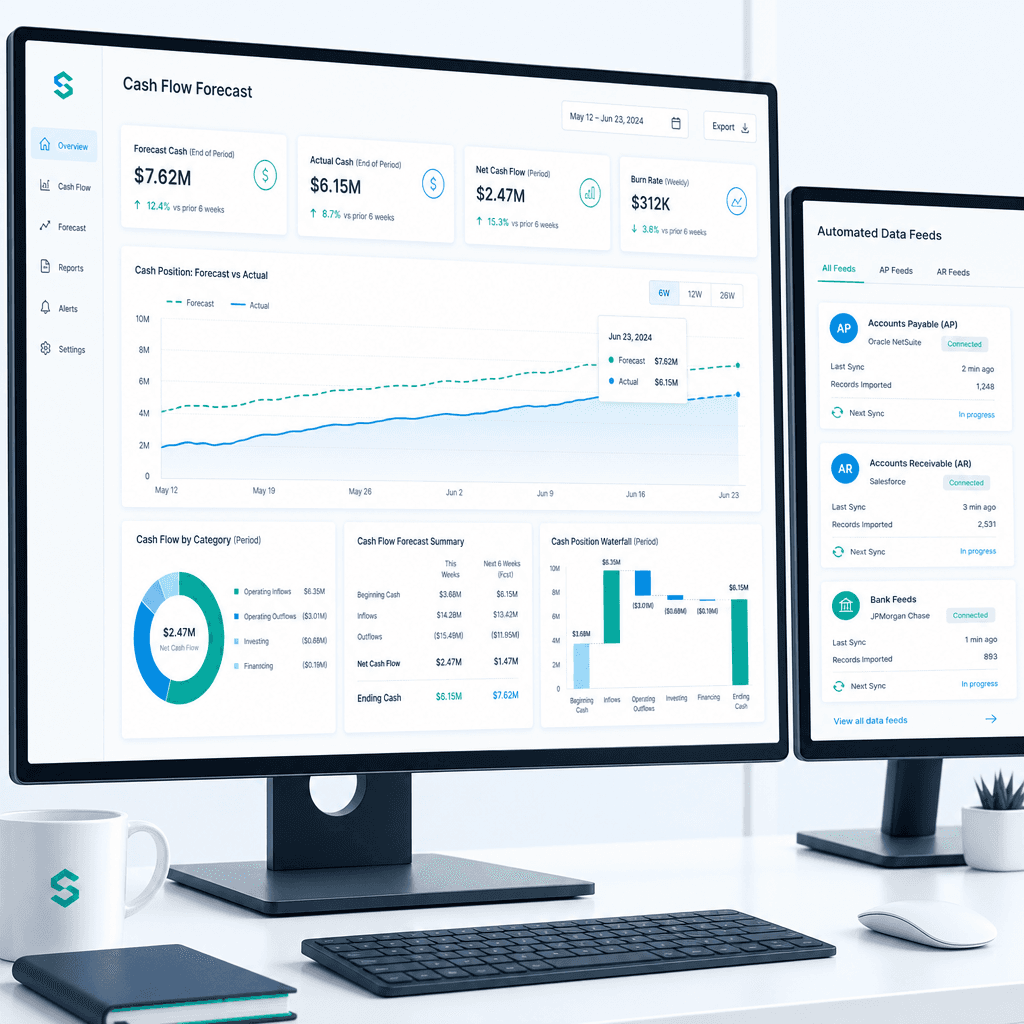
Cash Flow Forecasting Automation: A Practical Guide for Australian Finance Teams (2026)
If your finance team rebuilds the cash flow forecast from scratch every week or every month, you already know where the time goes. Someone pulls an AR ageing…
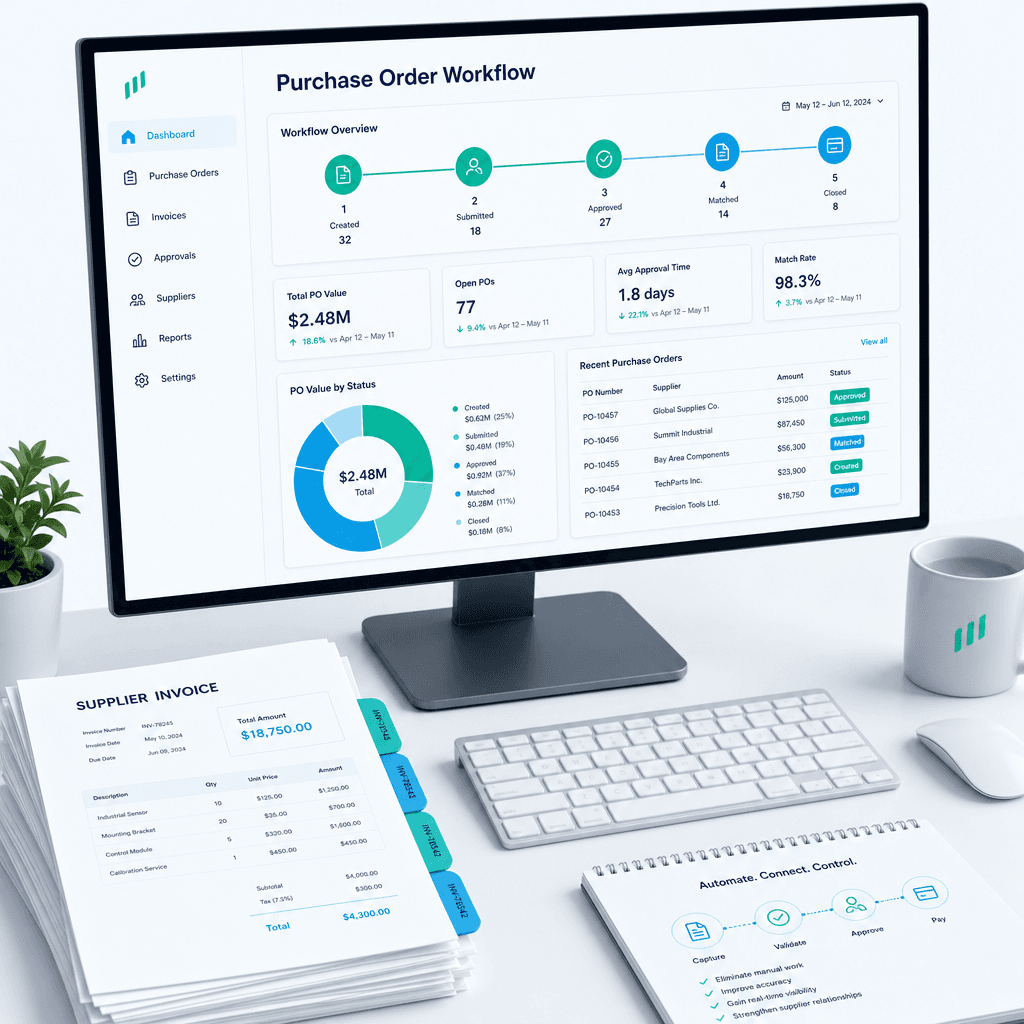
Purchase Order Automation: A Practical Guide for Australian Finance Teams (2026)
If your finance team is still raising purchase orders in a shared inbox, chasing approvals over email, and manually matching invoices line by line before month…
Finance Automation Buyer's Guide for Australian Finance Teams: How to Choose, Scope & Measure Automation That Delivers (2026)
Most finance automation buying decisions are made the wrong way. Teams evaluate vendors on feature lists, watch polished demos, and sign contracts based on…