
How Much Does Finance Automation Cost in Australia? A Pricing Guide for CFOs (2026)
Ordron29 min read
Ask three finance automation vendors for a quote and you will get three completely different answers. One will talk about platform licensing, another will lead with implementation day rates, and the third will present a monthly subscription that somehow does not include the integrations you actually need. CFOs end up comparing apples with engine parts, and the decision stalls.
This guide exists to fix that. It breaks down every cost component of finance automation in Australian dollars, across small businesses, mid-market operators, and enterprise teams. It covers software licensing models, implementation and integration fees, the costs that vendors rarely mention upfront, and how to calculate whether any of this pays back. The numbers come from real engagements, not vendor marketing decks.
One thing worth stating plainly before we start: cost without context is a meaningless number. A $120,000 implementation that returns 160 hours per month to a finance team and eliminates a reconciliation error rate that was costing six figures annually is not expensive. A $15,000 platform licence that automates a process nobody actually bottlenecked on is waste. The question is never "how much does it cost?" It is always "what does it return?"
Key Takeaways
- Finance automation costs in Australia range from around $500 per month for entry-level SME tools to well over $200,000 for enterprise implementations, depending on scope, system complexity, and the number of integrations required.
- Software licensing, implementation, integration, change management, and ongoing support are all separate cost buckets. Vendors who quote only one of them are not giving you the full picture.
- Implementation and integration typically represent the largest single cost for mid-market and enterprise projects, often exceeding first-year software licensing fees.
- Payback periods for well-scoped finance automation projects in Australia typically fall between 6 and 18 months, depending on labour cost saved and error reduction.
- The biggest driver of cost blowout is starting with the software rather than the process. Scope the manual work first, then choose the tool.
- Automation layers built around existing systems, including legacy ERPs with no APIs, can deliver equivalent efficiency gains at a fraction of the cost and risk of a platform replacement.
Summary Table: Finance Automation Cost Ranges by Component (AUD, 2026)
| Cost Component | SME (under 50 staff) | Mid-Market (50-500 staff) | Enterprise (500+ staff) |
|---|---|---|---|
| Software Licensing (annual) | $6,000 - $24,000 | $24,000 - $120,000 | $120,000 - $500,000+ |
| Implementation (one-off) | $5,000 - $30,000 | $30,000 - $150,000 | $150,000 - $600,000+ |
| Integration (one-off, per system) | $2,000 - $10,000 | $10,000 - $50,000 | $30,000 - $150,000+ |
| Change Management and Training | $1,000 - $8,000 | $8,000 - $40,000 | $30,000 - $120,000 |
| Ongoing Support and Maintenance (annual) | $3,000 - $12,000 | $12,000 - $60,000 | $50,000 - $200,000+ |
| Estimated Year-One Total | $17,000 - $84,000 | $84,000 - $420,000 | $380,000 - $1,500,000+ |
These are realistic market ranges based on Australian project data. Your actual number depends on scope, vendor selection, and system complexity. Every figure here should be treated as a starting point for scoping, not a quote.
What Actually Drives Finance Automation Cost in Australia
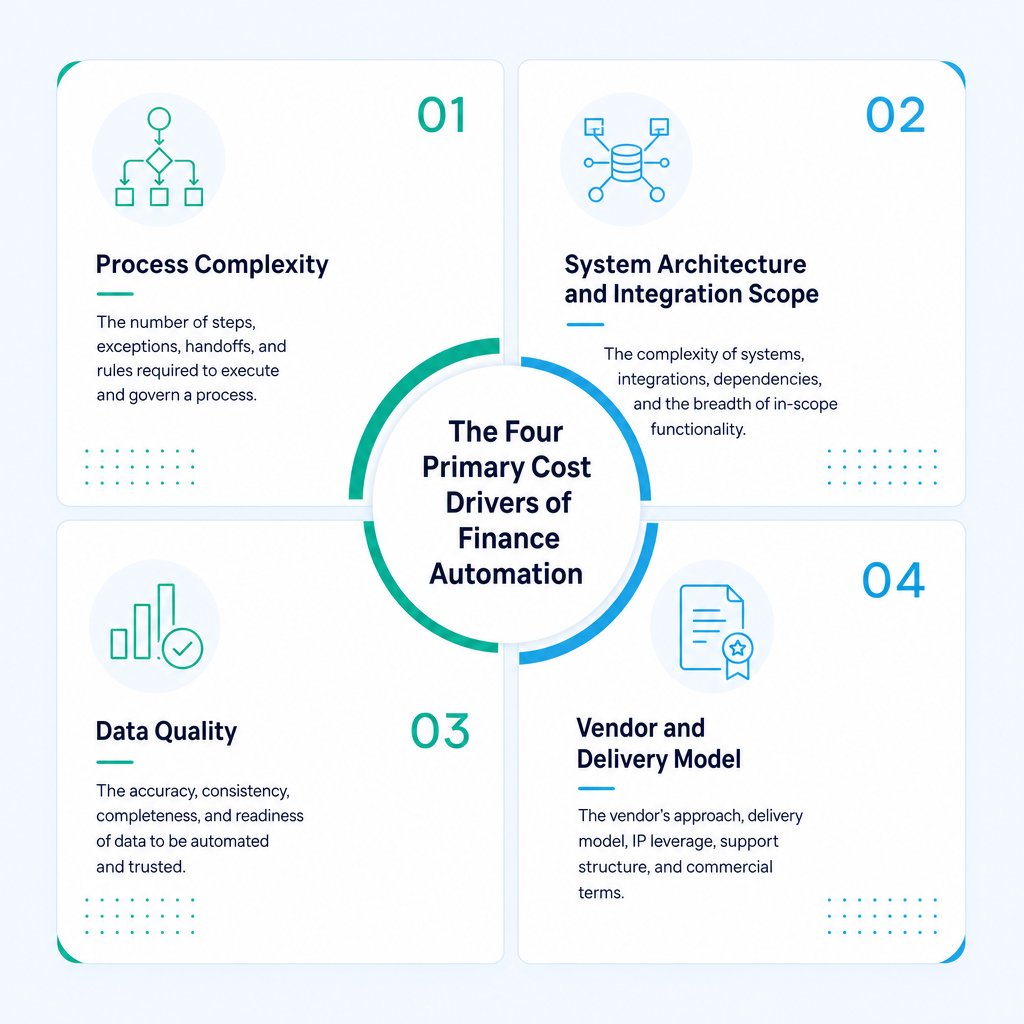
Most CFOs assume that software licensing is the primary cost driver. In straightforward SME deployments, that is sometimes true. In every other context, it is not. The real cost drivers are process complexity, system architecture, data quality, and integration scope. Understanding them before you issue an RFQ will save you from scope creep that doubles your budget post-contract.
Process Complexity
A finance automation project that targets accounts payable for a business processing 200 invoices per month from 30 suppliers with consistent formats is a fundamentally different engineering problem from one targeting AP for a national operator processing 5,000 invoices per month across 400 suppliers with inconsistent formats, multiple cost centres, and delegated approval hierarchies. The labour saved by the second project is orders of magnitude larger. So is the cost to build it.
Process complexity is measured in the number of decision points, exception types, approval tiers, and document format variations a workflow must handle. Each additional variable adds engineering time. A flat AP workflow with two approval steps and a single ERP destination might take 40 hours to automate. Add multi-currency, three ERP destinations, and a delegated authority matrix, and you are looking at 200 hours minimum.
System Architecture and Integration Scope
Every system your finance data needs to touch is a billable integration. Xero to a single reporting dashboard is one integration. Xero to a legacy ERP, two banking portals, a payroll platform, and a Power BI layer is five integrations, each with its own authentication, data mapping, error handling, and testing cycle.
Legacy systems without modern APIs, such as ERPs that were implemented before API-first architecture became standard, present a specific challenge. Replacing them is expensive and risky. Building automation around them, which is the approach we take at Ordron, eliminates that cost entirely. I worked with a family-owned logistics operator whose twenty-year-old ERP had no APIs at all. Their finance team was spending over 160 hours per month manually re-keying data between that ERP and Xero. Rather than recommending a migration, we built an RPA bot that drove the legacy ERP interface directly, validated the extracted data against SQL, and synced clean records into Xero and live reporting dashboards. The ERP stayed in place. The 160-plus hours per month came back to the finance team. That kind of outcome is not possible if you start with the assumption that the legacy system has to go.
Data Quality
Poor data quality is one of the most reliable cost multipliers in any automation project. If your supplier master is incomplete, your chart of accounts is inconsistent, or your historical invoice data contains formatting irregularities, significant engineering time will be spent on data remediation before any automation logic can be built. Vendors who quote without assessing data quality first are setting you up for a change order.
Vendor and Delivery Model
Whether you engage a global SaaS platform, a boutique Australian automation consultancy, or build in-house determines both the cost structure and the risk profile. Global platforms charge for breadth of features you may not use. Boutique consultancies charge for fit-to-purpose engineering. In-house builds carry a fully loaded labour cost plus the opportunity cost of your IT team's time. We cover this in detail in the in-house versus partner-led section below.
Software and Licensing Models: What You Are Actually Paying For
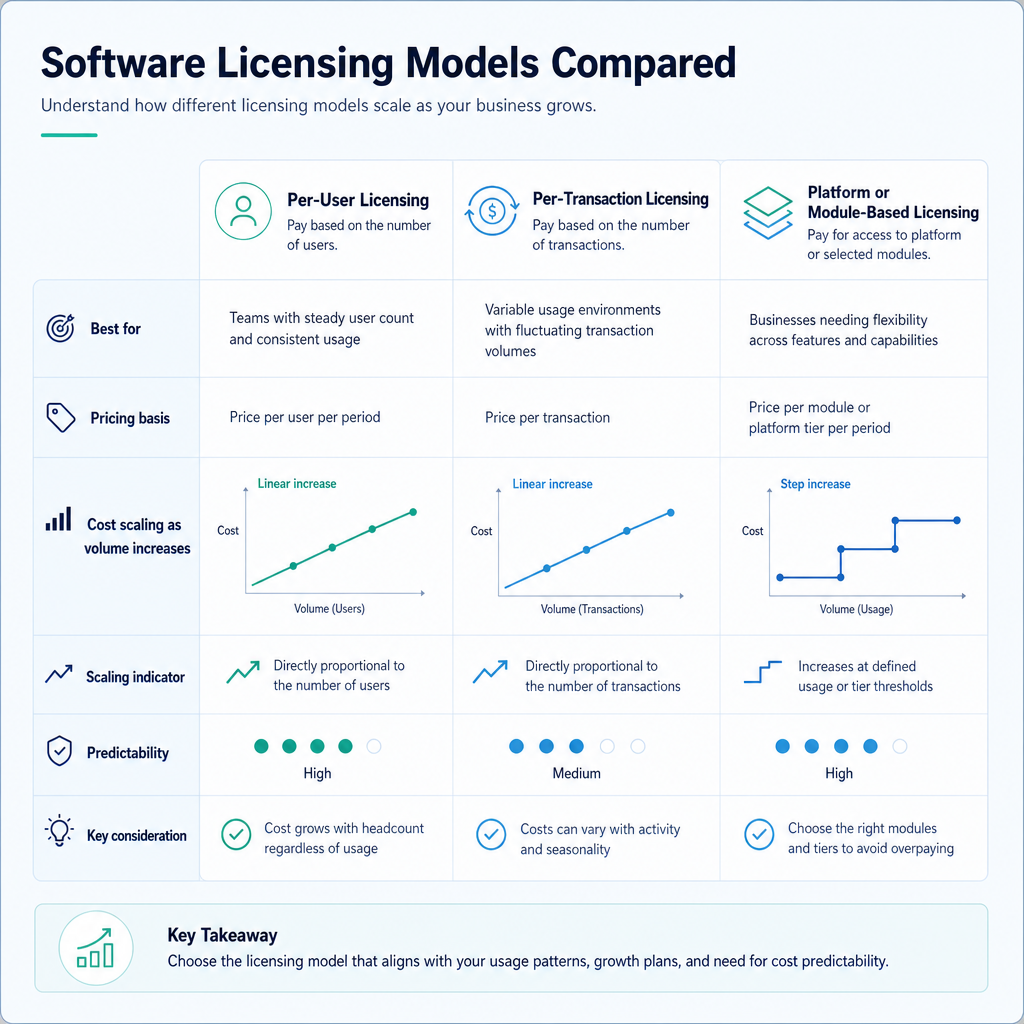
Finance automation software is sold through several distinct licensing models, and the model matters as much as the headline price because it determines how your costs scale as your business grows.
Per-User Licensing
Common in platforms like Xero, MYOB, and their add-on ecosystems, per-user pricing charges a fixed monthly fee for each person who has access to the system. For small finance teams of two to five people, this is often the most cost-effective entry point. At scale, it becomes expensive. A mid-market business with 15 finance team users on a $120 per user per month platform is paying $21,600 per year in licensing alone before any implementation costs.
For a detailed comparison of which platforms use this model and what they include at each tier, see our finance automation tools comparison for Australia.
Per-Transaction or Consumption-Based Licensing
Some AP automation and OCR platforms charge per invoice processed or per transaction run through the platform. This model can be attractive for businesses with variable invoice volumes but creates unpredictable cost exposure for high-volume operators. A platform charging $1.50 per invoice processed sounds reasonable until you are processing 4,000 invoices per month and paying $6,000 monthly in processing fees alone.
Platform or Module-Based Licensing
Enterprise platforms, particularly ERP-native automation modules from vendors like Oracle NetSuite, SAP, and Microsoft Dynamics, charge for access to automation modules as add-ons to the core platform licence. These costs are often negotiated annually and depend on the number of modules activated, the number of legal entities, and transaction volume thresholds. Annual licence fees at this tier routinely start at $80,000 and climb past $500,000 for large deployments.
Custom or Project-Based Pricing
RPA and bespoke workflow automation built by a partner or in-house team typically carries no ongoing licensing cost beyond tool infrastructure (which for cloud-based RPA platforms like UiPath or Power Automate is generally $3,000 to $20,000 per year depending on bot count and complexity). The cost is front-loaded into the build, making the economics more favourable over a three-to-five-year horizon compared to high-volume SaaS licensing.
Implementation and Integration Costs: The Numbers Vendors Bury
Implementation is where finance automation budgets most commonly blow out, and it is the cost component most frequently underrepresented in vendor proposals. A platform that quotes a $2,000 per month licensing fee may require $80,000 in implementation services to go live in a mid-market environment. Understanding what drives implementation cost gives you the tools to pressure-test any quote you receive.
What Implementation Actually Includes
A properly scoped implementation project includes process mapping and discovery (understanding the current state manual workflows before any automation is built), system configuration, custom logic development, integration build and testing, UAT (user acceptance testing) with your finance team, parallel run, and go-live support. Each phase has a time cost, and in Australia, implementation day rates from qualified automation partners range from $1,500 to $3,500 per day depending on seniority and specialisation.
A lightweight SME implementation scoped at 15 to 20 days sits at $22,500 to $70,000. A complex mid-market project scoped at 60 to 100 days sits at $90,000 to $350,000. Enterprise projects regularly exceed 150 days of delivery effort across multiple workstreams.
Integration Costs by Common Australian Platform
Australia's mid-market finance ecosystem is dominated by Xero, MYOB, and NetSuite, with Xero holding strong market share among SMEs and growing into mid-market. Integration costs depend on whether native connectors exist and how much custom mapping is required.
Xero integrations are generally the most accessible. Xero's API is well-documented and widely supported, and native connectors exist for most common AP automation tools. A standard integration between an OCR/AP platform and Xero typically costs $2,000 to $8,000 for a straightforward setup. Add complexity through custom field mapping, multi-entity Xero environments, or non-standard workflows, and costs move toward $15,000 to $30,000.
MYOB integrations are more variable. MYOB AccountRight and MYOB Advanced have different API capabilities, and MYOB Advanced in particular often requires MYOB-certified partner involvement, which limits the field of providers and can add cost. Budget $5,000 to $25,000 for a well-scoped MYOB integration depending on the platform version and workflow complexity.
NetSuite integrations are typically the most expensive because NetSuite's architecture, while powerful, requires SuiteScript or SuiteTalk development, and qualified NetSuite developers in Australia command premium rates. Budget $15,000 to $60,000 for a non-trivial NetSuite integration. For a full picture of how these platforms compare on automation capability, the finance automation tools comparison covers each in detail.
Legacy ERP integrations without API support require a different approach entirely. As described above, RPA-based integration layers can bridge legacy systems to modern platforms without replacement. The build cost for this kind of integration sits between $20,000 and $80,000 depending on ERP complexity, but the saving compared to an ERP migration, which typically costs $200,000 to $1,500,000 for a mid-market operator, makes it a straightforward comparison.
For a realistic picture of how long all of this takes from decision to go-live, see our finance automation implementation timeline guide.
Hidden Costs: What the Proposal Does Not Include
Every finance automation proposal I have reviewed on behalf of a client has left out at least two of the following cost categories. Not always deliberately, but because vendors scope what they sell, not what the project actually requires.
Change Management and Training
Finance automation changes how people work. AP staff who have spent five years manually keying invoices will need structured training, a transition period, and ongoing support as they adapt to exception-only workflows. Mid-market businesses that skip formal change management programmes consistently report lower adoption rates, more exception escalations than projected, and longer payback periods.
Change management costs in Australia typically range from $8,000 to $40,000 for mid-market projects. This includes stakeholder communication, training material development, live training sessions, and a hypercare period post go-live. For enterprise deployments across multiple sites or business units, this cost is substantially higher.
Internal Resource Time
Your finance team and IT function will spend significant hours on any automation implementation, regardless of who leads the project. Discovery workshops, UAT, data preparation, parallel running, and go-live support all consume internal time that has a real cost. A conservative estimate for a mid-market project is 80 to 150 hours of internal resource time across the implementation period. At a blended finance and IT cost of $80 to $120 per hour fully loaded, that is $6,400 to $18,000 of internal cost that never appears in a vendor proposal.
Maintenance and Iteration
Automation is not a set-and-forget deployment. Supplier invoice formats change. Approval hierarchies get restructured. Chart of accounts evolves. ERP versions are updated. Each of these events can break automation logic that was working correctly, and somebody has to fix it. Annual maintenance and support costs for mid-market finance automation range from $12,000 to $60,000 depending on scope and the number of integrations involved. Some vendors bundle a support tier into annual licensing. Most do not include proactive maintenance.
Compliance and Security Uplift
If your automation project touches personally identifiable information, payroll data, or payment processing, you may need to invest in compliance review and security uplift to meet Australian Privacy Act obligations. The OAIC (Office of the Australian Information Commissioner) and ATO both have specific guidance on data handling in automated finance contexts. Budget $5,000 to $20,000 for a privacy impact assessment and any required security controls if your project touches sensitive data categories.
Finance Automation Cost by Business Size
SME: Under 50 Staff
For small businesses, the most cost-effective entry into finance automation is typically through the native automation features of their existing accounting platform plus targeted add-ons. Xero's automation features, combined with a receipt-capture tool like Hubdoc or Dext and a bank reconciliation rules setup, can eliminate significant manual work for under $500 per month in software costs. Implementation at this level is often self-service or requires only a few days of consultant time, putting total year-one cost between $10,000 and $30,000.
The honest caveat for SMEs is that the available budget limits the scope of what can be automated. Entry-level tools handle straightforward workflows well. They struggle with multi-entity environments, complex approval hierarchies, or high invoice volume with format variability. If your business has any of those characteristics, the mid-market cost range is more appropriate even if your headcount sits under 50.
For SMEs asking whether automation is worth the investment at all, the answer almost always depends on labour cost saved. If your current manual AP process consumes 20 hours per month of staff time at a fully loaded cost of $60 per hour, that is $14,400 per year. A $500 per month automation tool that recovers 15 of those hours pays back in under four months.
Mid-Market: 50 to 500 Staff
This is the segment where finance automation delivers its most consistent and measurable return, and where the cost structure becomes genuinely complex. Mid-market businesses typically have enough transaction volume for automation to generate meaningful savings, enough system complexity to require proper integration work, and enough organisational structure to require formal change management.
Realistic year-one costs for a well-scoped mid-market automation project in Australia sit between $80,000 and $420,000 depending on scope. That range is wide because mid-market is wide. A 60-person professional services firm automating Xero-based AP with a single integration is a different project from a 300-person distributor automating AP, AR reconciliation, GL coding, and management reporting across four entities and two ERPs.
I worked with a national logistics provider in this segment that ran its AP process inside SharePoint across multiple depots. Each invoice batch required manual handling from capture through to filing, with a full cycle taking around four hours per batch. We plugged OCR and workflow logic directly into the existing SharePoint process, no new software introduced. Automated filing handled 100 per cent of documents once the logic was live. AP cycle time dropped from four hours to fifteen minutes per batch. The implementation cost was a fraction of what a platform replacement would have required, and the finance team did not have to change their core working environment.
Enterprise: 500+ Staff
Enterprise finance automation is a programme of work, not a project. Multiple workstreams, phased delivery, dedicated programme management, and extensive stakeholder engagement are standard. Year-one costs routinely exceed $500,000 and can approach $1,500,000 for large organisations with complex, multi-entity, multi-platform environments.
At this scale, the procurement process itself has a cost. Tender preparation, vendor evaluation, contract negotiation, and security assessment can consume three to six months and $30,000 to $80,000 in internal and advisory time before any development work begins.
The payback case at enterprise scale is usually compelling despite the higher cost. A large enterprise finance team processing high monthly invoice volumes across multiple cost centres can see measurable returns within the first year. In one enterprise engagement, we combined RPA with intelligent document understanding to read, PO-match, and code supplier invoices automatically, routing only exceptions to human reviewers. Coding accuracy exceeded 95 per cent and invoice processing speed increased by 65 per cent. At that volume, the hours returned and error costs eliminated ran well ahead of the implementation investment within twelve months of go-live.
One-Off Versus Ongoing Costs: How the Structure Shifts Over Time
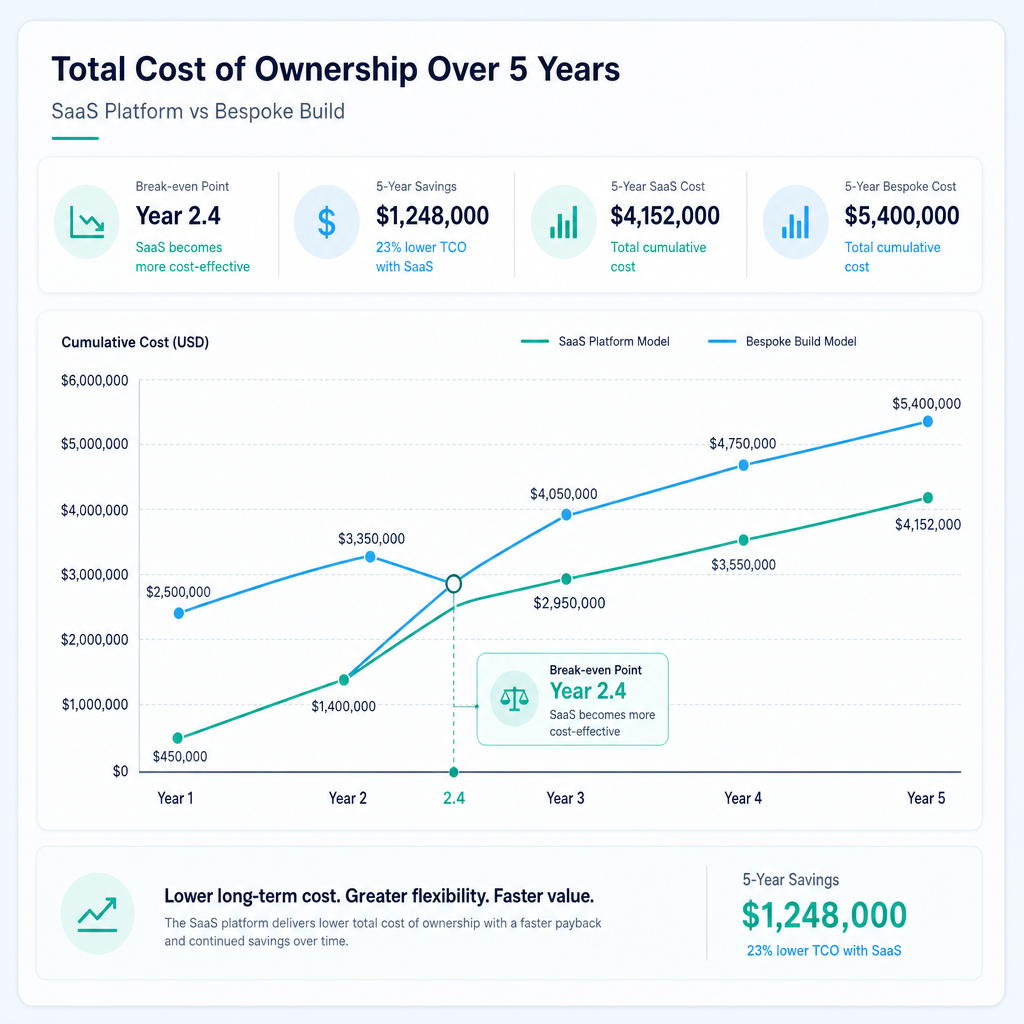
One of the most common mistakes in finance automation business cases is treating the implementation cost as the total cost. The real economic question is what you pay in year one versus year two and beyond, and how that changes depending on whether you choose a SaaS platform or a bespoke build.
SaaS platform model: Year one is high because it includes both implementation and the first year of licensing. From year two, costs drop to licensing plus ongoing support and maintenance. The risk is licensing cost inflation. SaaS vendors regularly increase prices at renewal, and switching costs are high once your processes are built around a platform.
Bespoke build or RPA model: Year one is high because the build cost is front-loaded. From year two, costs are limited to infrastructure, maintenance, and any iteration work. Over a five-year horizon, bespoke builds often have a lower total cost of ownership than SaaS platforms for mid-market and enterprise deployments, particularly where transaction volumes are high.
The practical guidance here is to model costs over three years minimum. A platform that costs $30,000 in year one and $18,000 annually thereafter has a three-year total cost of $66,000. A bespoke build that costs $80,000 in year one and $8,000 annually thereafter has a three-year total cost of $96,000. At face value the platform wins. But if the bespoke build delivers $60,000 per year in labour savings and the platform delivers $35,000, the three-year net position reverses entirely.
How to Calculate Your Payback Period: A Worked AUD Example
Payback period calculation for finance automation is straightforward in principle and often complicated in practice by businesses that count aspirational savings rather than measured outcomes. Here is how to do it honestly.
Step 1: Quantify the current cost of the manual process
Identify every manual task the automation will replace. Count the hours consumed each month. Apply a fully loaded hourly cost (salary plus superannuation plus overhead, typically $55 to $95 per hour for a finance officer in Australia depending on market). Add any error-related costs: late payment penalties, reconciliation errors, duplicate payments, or compliance failures that have a dollar value.
Example: A mid-sized freight operator processes AP manually. The process consumes 40 hours per month of a senior finance officer's time at a fully loaded cost of $75 per hour. That is $3,000 per month, or $36,000 per year. In addition, the manual process generates an average of two duplicate payments per quarter at an average of $4,500 each, costing $9,000 per year in recovered or written-off overpayments. Total current cost: $45,000 per year.
Step 2: Estimate the post-automation cost of the same process
After automation, the same AP process requires exception handling only. Estimate that exceptions consume 6 hours per month rather than 40. Monthly cost drops to $450. Annual cost: $5,400.
Step 3: Calculate annual saving
Annual saving: $45,000 minus $5,400 equals $39,600. Add duplicate payment elimination: $9,000. Total annual saving: $48,600.
Step 4: Divide total implementation cost by annual saving
Total implementation cost (software year one plus implementation plus integration plus change management): $95,000.
Payback period: $95,000 divided by $48,600 equals 1.95 years, or approximately 23 months.
From year three, the project generates net savings of $39,600+ per year after ongoing support costs. Over five years, net return exceeds $100,000 on a $95,000 investment.
For a more detailed framework on building this business case for your CFO or board, the finance automation ROI business case guide covers the full methodology. If you want to see what metrics Australian CFOs should be tracking to measure ROI after go-live, the ROI calculator framework is the right starting point.
In-House Versus Partner-Led: Cost and Risk Comparison
Building finance automation in-house is a legitimate option for organisations with mature internal data and engineering capability. It is also regularly undercosted in the initial business case, leading to projects that run over budget and under-deliver.
The True Cost of an In-House Build
The visible cost of an in-house build is the internal team's time. A senior developer or business analyst in a finance technology function earns $120,000 to $180,000 per year in Australia. A project that requires six months of one developer's time at the higher end of that range costs $90,000 in direct labour, plus superannuation (currently 11.5% under the Superannuation Guarantee), plus tools, infrastructure, and any specialist training. The total is typically $100,000 to $130,000 for a single developer over six months.
The hidden cost is opportunity cost. That developer's six months is six months not spent on other engineering priorities. For most mid-market finance functions, using an external partner to deliver a defined, scoped automation project and redirecting internal engineering capacity to core product or systems work is the more economical choice.
What a Partner-Led Engagement Actually Delivers
A qualified automation partner brings pre-built connectors, documented delivery methodology, and the accumulated knowledge of having solved similar problems across multiple clients. At Ordron, the work we have shipped across eight industries means that a logistics operator's AP automation project benefits from patterns developed across freight, distribution, and manufacturing clients. That cross-industry learning compresses delivery timelines and reduces the iteration cycles that blow out in-house builds.
The risk profile is also different. An external partner has contractual accountability for delivery. An internal build has none. That accountability matters when a scope change arises at week eight of a twelve-week project.
For guidance on selecting the right automation partner in Australia, including what questions to ask and what contract terms to insist on, the finance automation partner selection guide covers this thoroughly.
When In-House Makes Sense
In-house builds are most appropriate when the automation requirement is highly proprietary, when your business has genuinely mature internal data engineering capability, or when the automation will need continuous iteration that makes a project-based external engagement impractical. Large enterprises with dedicated data engineering teams and well-defined internal platforms often fall into this category.
Realistic Caveats: Why Your Quote Will Differ from These Ranges
Every cost range in this guide is based on real Australian project data, but none of them is a quote for your specific situation. Here is what will push your number above or below the midpoints.
Scope Creep Is the Primary Cost Driver
The single most reliable cause of finance automation cost blowout is scope expansion during delivery. Discovery reveals more process complexity than anticipated. Stakeholders request additional features. A new approval workflow is required that was not in the original brief. Rigorous discovery and a fixed scope agreement before development begins are the only effective controls.
System Complexity Multiplies Everything
The number of systems involved, the age of those systems, the quality of their documentation, and the consistency of the data they contain all multiply every cost line. A single Xero integration in a clean data environment is a different proposition from a three-system integration where one of the systems is a legacy ERP with no documentation and inconsistent data.
Vendor Selection Affects Both Cost and Risk
Not all automation vendors price or deliver equivalently. A global SaaS platform will charge more for licensing and less for implementation because implementation is handled by partners who charge separately. A boutique Australian consultancy charges more for delivery and nothing for licensing if the build is platform-agnostic. Understanding which model fits your budget and risk tolerance is as important as understanding the headline cost.
Australian Market-Specific Factors
The ATO's requirements around payroll tax, GST treatment, and BAS reporting create compliance constraints that offshore vendors sometimes underestimate. Australian privacy law under the Privacy Act 1988 and the OAIC's guidance on automated decision-making add compliance considerations that are not relevant in other markets. Any automation touching payroll, supplier payments, or customer data needs to be scoped with these requirements in mind, and that adds time and cost that a purely offshore vendor may not budget for correctly.
Australia's skilled labour market also affects delivery cost. The ABS labour force data consistently shows that demand for business analysts, data engineers, and implementation consultants in Australia outpaces supply in major capitals, supporting the day rates cited above. Budget squeezes that try to bring these costs below market rates consistently result in under-qualified delivery teams and extended timelines.
What Ordron's Published Outcomes Actually Show
Most automation case studies name the client and obscure the numbers. Ordron inverts that. We withhold client names and publish the measured outcomes, because the numbers attached to an engagement are the evidence, not the brand on the letterhead.
Across eight industries, the maximum manual work reduction we have measured after go-live is 85 per cent. The hours returned figure of 160-plus per month at a single logistics client is a single engagement outcome, not a projected average. The 95 per cent AP coding accuracy figure and 65 per cent increase in processing speed at an enterprise distribution client are measured after go-live, not projected at proposal stage. The 80 per cent reduction in AR reconciliation time at a mid-sized freight operator running Xero is the post-implementation measured figure, not an aspiration.
These are anonymised outcomes, not aspirational projections. The specifics are the credibility. You can see the full set of measured results across our case studies at the Ordron case studies page.
The consistent pattern across this work is that the tool follows the problem. The logistics operator whose legacy ERP had no APIs did not need an ERP replacement. The national logistics provider whose AP ran in SharePoint did not need a new AP platform. They needed automation built precisely around their existing friction points. That discipline, scoping the minimum intervention required to eliminate a specific bottleneck, is what keeps implementation costs contained and payback periods short.
Is Finance Automation Worth It for Australian Businesses in 2026?
The cost-benefit case for finance automation in Australia has strengthened over the past two years for three reasons.
First, labour costs are rising. The ABS wage price index has tracked consistent growth in administrative and finance sector wages, increasing the dollar value of each hour of manual processing your team is doing. The same automation ROI formula produces a larger return as the hourly cost of the manual alternative rises.
Second, the tooling has matured. Platforms like Xero, MYOB, and NetSuite have deepened their native automation capabilities. OCR and intelligent document understanding have improved substantially. RPA platforms are more stable and easier to maintain than they were three years ago. The cost of achieving a given automation outcome is lower now than it has been at any point in the past decade.
Third, Australian businesses that have already automated are pulling ahead on operational efficiency, reporting speed, and cash flow visibility. The businesses that have not are competing with manual processes against teams that have automated equivalents. That competitive gap compounds over time.
The caveats are real. Finance automation does not work if the underlying process is not understood. It does not work if data quality is poor and nobody fixes it. It does not pay back if the scope was chosen to fill a platform's feature set rather than to address a genuine bottleneck. But scoped correctly, targeted at real friction, and measured honestly after go-live, finance automation consistently delivers returns that justify the investment. The question for most Australian CFOs is not whether to automate but where to start and how to scope it correctly.
If you want to find your automation quick wins before committing to a full scoping engagement, start with the processes that consume the most manual hours and have the clearest measurable output. AP and AR are the most common starting points because the before-and-after measurement is unambiguous. Bank reconciliation, management reporting, and payroll journals are close behind.
References
-
Australian Bureau of Statistics, Wage Price Index, Australia (2026 release): The ABS WPI tracks quarterly changes in the price of labour across Australian industries, including administrative and finance functions. Used to contextualise the rising dollar value of manual finance processing hours.
-
Australian Taxation Office, Business Technology and Digital Record-Keeping Guidance: The ATO publishes guidance on digital record-keeping requirements, automated reporting obligations, and the compliance requirements for businesses using automated accounting systems. Relevant to understanding the regulatory context for Australian finance automation deployments.
-
Xero Limited, Small Business Insights Australia (2026): Xero's ongoing Small Business Insights series tracks financial health, payment times, and technology adoption across Australian SMEs. Provides market context for platform penetration and automation adoption rates.
-
MYOB, Australian Business Monitor Report (2026): MYOB's annual Australian Business Monitor covers technology adoption, payroll and compliance burden, and automation sentiment among Australian SMEs and mid-market operators.
-
Office of the Australian Information Commissioner (OAIC), Guide to Data Analytics and the Australian Privacy Principles: The OAIC guidance document covers obligations for Australian businesses using automated data processing, including finance automation systems that handle personally identifiable information. Directly relevant to compliance cost scoping.
-
Ordron, Finance Automation Case Studies (2026): Ordron's published case study outcomes, covering measured results across eight industries. All figures cited in this article as Ordron outcomes are drawn from post-go-live measurement, not pre-implementation projections.
Frequently asked questions
- What is the typical monthly cost of finance automation in Australia?
- For SMEs on entry-level tools, monthly costs sit between $500 and $2,000 covering software licensing and ongoing support. Mid-market businesses with a fully implemented solution typically spend $3,000 to $15,000 per month when implementation costs are amortised across a three-year period. Enterprise deployments can exceed $30,000 per month on the same basis.
- What is the cheapest entry point for finance automation in Australia?
- For a small business already on Xero or MYOB, the cheapest entry point is using native automation features combined with a document capture add-on like Hubdoc or Dext. Total software cost can be under $300 per month. This covers straightforward bank reconciliation rules, automated receipt capture, and basic approval workflows.
- Why do finance automation quotes vary so much between vendors?
- Because different vendors quote different things. Some quote software licensing only and exclude implementation. Some quote implementation but exclude ongoing support. The only way to compare quotes accurately is to request a total cost of ownership figure that includes licensing, implementation, integration, change management, and annual ongoing costs, all in the same document.
- What percentage of the total cost should ongoing support and maintenance represent?
- For a well-implemented finance automation project, annual ongoing support and maintenance should represent 15 to 25 per cent of the original implementation cost. If ongoing costs exceed 35 per cent annually, re-examine whether a bespoke build with lower maintenance overhead would be more economical over a three-to-five-year horizon.
- What is a realistic ROI timeframe for finance automation in Australia?
- For well-scoped projects targeting genuine bottlenecks, payback periods in Australia typically fall between 6 and 18 months. SME projects with modest implementation costs and clear labour savings can pay back in under 6 months. Complex mid-market or enterprise projects typically sit between 12 and 24 months.
- What are the hidden costs of finance automation that vendors do not mention?
- The most consistently underrepresented cost items are: internal resource time during implementation (typically 80 to 150 hours for a mid-market project), change management and training, ongoing maintenance when automation logic breaks due to supplier or system changes, compliance review for projects touching sensitive data, and data remediation required before automation logic can be built.
- Is finance automation worth it for Australian SMEs?
- For SMEs where manual finance processes consume more than 10 hours per month of staff time, the answer is usually yes with appropriate scoping. For most SMEs processing more than 50 invoices per month or spending more than 15 hours per month on reconciliation, even entry-level automation tools produce a positive return within the first year. The risk for SMEs is over-scoping: buying a platform with enterprise features they do not need increases cost and complexity without increasing the return.
Ordron
Finance automation team, Sydney
Ordron builds the finance automation infrastructure that runs AP, AR, reconciliations and reporting on autopilot for Australian mid-market businesses.
More from the Ordron Insights catalogue
Selected by topic. Updated as the agent publishes.
Finance Automation ROI Benchmarks for Australian Businesses: What Good Actually Looks Like
Every vendor selling finance automation will show you a projected ROI slide. The numbers are always impressive: cost savings in the hundreds of thousands,…
Finance Automation for Retail & eCommerce in Australia: How to Streamline AP, Inventory Reconciliation & Multi-Channel Reporting
Australian retail and eCommerce finance teams are operating in one of the most data-intensive environments in any industry. You are simultaneously managing…
How to Automate Purchase Orders in Australia: A Practical Guide for Finance Teams
Most Australian finance teams are still processing purchase orders the same way they were a decade ago: an email chain, a spreadsheet, a PDF attachment, and…