
Month-End Close Taking Too Long? How Australian Finance Teams Are Cutting Close Time in Half
Ordron31 min read
The average mid-market finance team takes 10 to 15 business days to close the books each month. That is two to three full working weeks consumed before leadership can see a single verified number. In a business environment where decisions need to be made on current data, not data that is already three weeks old, that gap is not a minor inconvenience. It is a structural problem with a measurable cost.
If your team is still running the close across disconnected spreadsheets, chasing journal entry approvals through email chains, and manually reconciling intercompany transactions at 9pm on a Tuesday, you are not alone. But you are also not stuck. The finance teams that have closed that gap to five days or fewer have not done it by working longer hours. They have done it by identifying the specific steps in their close process that are absorbing the most time and attacking those steps with a combination of process discipline and targeted automation.
This post is both a diagnostic and a fix guide. We will walk through the most common bottlenecks in the Australian mid-market close, the actual cost of leaving them unaddressed, and the practical path from a 15-day close to a 5-day close. No aspirational projections. Just what the evidence shows, and what has worked in practice.
Key Takeaways
- The five most common month-end close bottlenecks are manual journal entries, intercompany reconciliations, disconnected systems, approval delays, and spreadsheet dependency.
- A slow close is not just an inconvenience. It delays decision-making, increases audit risk, and consumes FTE hours that should be spent on analysis.
- Process fixes and automation fixes solve different problems. Getting the sequencing right matters as much as the tools you choose.
- A 5-day close is achievable for most Australian mid-market organisations without replacing existing systems like MYOB, Xero, or legacy ERPs.
- The right starting point is a clear diagnosis of where your close time is actually going, not a software purchase.
- Automation layered on an existing stack consistently outperforms rip-and-replace projects on both speed to value and return on investment.
Summary: Common Close Bottlenecks at a Glance
| Bottleneck | Typical Time Wasted Per Close | Fix Category |
|---|---|---|
| Manual journal entry preparation and posting | 2-4 days | Process + Automation |
| Intercompany reconciliations | 1-3 days | Process + Automation |
| Disconnected systems requiring manual data bridging | 2-5 days | Automation |
| Approval delays and email-based workflows | 1-2 days | Process |
| Spreadsheet dependency for consolidation and reporting | 2-4 days | Process + Automation |
| Accruals and prepayment calculations | 1-2 days | Automation |
Why the Month-End Close Still Takes So Long in 2026
The question worth asking first is not how to speed up the close. It is why the close is still slow despite years of investment in accounting software, cloud platforms, and ERP upgrades. The answer is almost never one thing. It is a combination of structural factors that compound each other.
The Australian Mid-Market Context
Australian businesses carry a few close-specific burdens that their counterparts in other markets do not always share. The BAS lodgement cycle means that GST reconciliation and reporting obligations land on top of the financial close, creating a compressed period where the same team is trying to close the books and meet ATO reporting deadlines simultaneously. For businesses registered for quarterly BAS, that pressure concentrates into a predictable crunch that many finance teams have simply normalised rather than engineered out.
Multi-entity structures are also more common than many people acknowledge in the mid-market. A privately-owned group running three to five trading entities, perhaps with a holding company and a property trust, faces intercompany elimination work that adds days to the close even when each entity's own books are clean. The ABS counts over 2.5 million actively trading businesses in Australia, and a significant proportion of mid-market operators have grown into multi-entity structures without ever building the consolidation infrastructure to support a fast close.
Then there is the systems reality. A large portion of Australian mid-market finance teams are running hybrid environments: Xero or MYOB for the accounting layer, a legacy ERP or operations platform that does not integrate cleanly, and a collection of spreadsheets bridging the gap. That gap is where close time goes.
I work with a family-owned logistics operator in exactly this position. They had a twenty-year-old ERP with no APIs sitting alongside Xero, and every month the finance team was manually bridging data between the two. Not because they had not tried to fix it, but because every solution they had been offered involved replacing the ERP, and the cost and disruption of that was not something they were willing to absorb. We built an RPA bot that drives the legacy ERP interface directly, validates data against SQL, and syncs clean records into Xero and reporting dashboards without replacing the ERP. The result was more than 160 hours per month returned to the finance team. The ERP is still running. The manual bridging is gone.
That outcome is not unusual. It is what happens when you fix the actual bottleneck instead of proposing a platform replacement.
Legacy System Debt
SAP, JD Edwards, MYOB AccountRight, and older versions of Microsoft Dynamics are all still in active use across Australian mid-market and enterprise finance teams. These platforms are not going anywhere quickly. ERP replacement projects take 12 to 36 months, cost significantly more than budgeted, and carry execution risk that most CFOs are not willing to accept. The idea that meaningful close improvement requires a system replacement first is one of the most persistent and most damaging misconceptions in finance operations.
The reality is that most close bottlenecks exist not inside the ERP but in the steps that happen around it: the manual data extracts, the spreadsheet transformations, the email-based approvals, the rekeying of data from one system into another. Those are process and integration problems, and they are solvable without touching the ERP.
The Normalisation Problem
Perhaps the biggest reason the close is still slow in 2026 is that many finance teams have adapted to the slowness rather than eliminating it. The 15-day close becomes the expected close. Staff plan their month around it. Management reporting timelines are set assuming it. And when someone raises the idea of improving the process, the response is often that there is no time to fix it because the team is too busy doing it.
This is the definition of a process that is consuming the capacity needed to fix itself. Breaking out of that cycle requires either an external diagnostic or a deliberate allocation of internal resource to process improvement work. That is true regardless of whether the solution is a process change, an automation, or both.
The 6 Most Common Close Bottlenecks
Across every close improvement engagement, the same problems appear in different combinations. Understanding which ones are consuming the most time in your specific close is the difference between a targeted fix and a wasted investment.
1. Manual Journal Entry Preparation and Posting
Journal entries are the core of the close. Accruals, prepayments, depreciation, payroll allocations, intercompany eliminations: each of these requires a journal, and in most mid-market finance teams, each journal is being manually prepared by a staff member, reviewed by a manager, and posted to the GL. When volumes are high, this process alone can consume two to four days of the close.
The manual preparation step is where the errors happen. A miskeyed amount, a wrong cost centre, a period-end accrual that gets duplicated from the prior month because the template was not updated. These errors are not the result of carelessness. They are the result of a process that depends on human accuracy under time pressure, which is exactly the type of process where automation delivers compounding value.
Recurring journals are the easiest win here. If the journal has the same structure and the same calculation logic every month, it should not require a human to prepare it. The calculation should be automated, the journal should be staged for review rather than prepared from scratch, and the posting should be triggered on a schedule rather than depending on someone remembering to do it.
2. Intercompany Reconciliations
For any business running more than one entity, intercompany reconciliations are a mandatory close step and frequently one of the most time-consuming. The challenge is that intercompany transactions need to agree across both entities, but they are often posted at different times, by different people, using different descriptions or reference codes. Finding the discrepancies, tracing them back to source, and resolving them before the consolidation can be finalised is painstaking manual work.
The problem compounds in groups with multiple entities and high intercompany transaction volumes. A group running five entities with active cost-sharing, management fee arrangements, and intercompany loan accounts can easily spend three days per close just on intercompany reconciliation.
The fix here is part process and part automation. On the process side, standardising how intercompany transactions are posted, including consistent reference codes and posting timing rules, eliminates a large proportion of the matching failures before they happen. On the automation side, automated matching and exception flagging tools can reduce the manual search-and-trace work to a fraction of its current time.
3. Disconnected Systems Requiring Manual Data Bridging
This is the bottleneck most finance teams have learned to live with, and it is often the largest single consumer of close time. When the payroll system does not feed the GL automatically, someone is exporting a report and rekeying the data. When the inventory system and the accounting system do not integrate, someone is reconciling stock movements manually. When the CRM and the billing system do not talk to the ERP, revenue recognition requires a spreadsheet.
Each of these manual bridges is a time sink and an error risk. And because they have been part of the close process for years, they often do not appear on anyone's list of things to fix. They are just how the close works.
The right question to ask is: which of these bridges is consuming the most time? Start there. In most cases, a targeted integration or RPA bot can eliminate the manual step without any change to the underlying systems. See our month-end close automation guide for a deeper walkthrough of which integration approaches work best for different system combinations.
4. Approval Delays and Email-Based Workflows
Approval workflows that run through email are a structural delay mechanism. The journal entry is prepared and sits in an inbox. The approver is travelling, or in meetings, or simply has not processed their email yet. The close schedule slips by half a day. This happens three or four times across the close period and suddenly you have lost two days to workflow latency.
This is a process problem before it is a technology problem. Defining clear SLAs for close approvals, setting a sequence for which approvals must happen before others can proceed, and moving approvals to a structured workflow tool rather than email chains eliminates most of the latency without requiring significant investment.
Where approval volumes are high, automated routing with escalation logic can further compress the time. The key principle is that humans should only be involved in approvals that genuinely require human judgement. Routine approvals that meet preset criteria should be auto-approved or pre-staged.
5. Spreadsheet Dependency for Consolidation and Reporting
The month-end close spreadsheet is a staple of Australian mid-market finance. It is also one of the most significant sources of close risk and close delay. When the consolidation model lives in Excel, every entity's trial balance needs to be imported manually, the intercompany eliminations need to be re-entered, the foreign currency adjustments need to be calculated, and the whole model needs to be checked for formula errors before anyone can trust the output.
This process is slow because it is sequential: each step depends on the previous one, and any error discovered late in the chain requires re-running from the point of failure. It is also high-risk because a single broken formula or overwritten cell can produce a materially incorrect result that is not immediately obvious.
Moving consolidation out of spreadsheets and into a structured tool, whether that is a purpose-built consolidation module, a configured reporting layer on top of the accounting system, or an automated data pipeline that feeds a clean reporting model, consistently reduces close time in this area by days rather than hours. You can see how we approached a similar problem in our manufacturing multi-system flows case study.
6. Accruals and Prepayment Calculations
Accruals are another area where manual preparation and high error rates combine to create a reliable close delay. When the accruals list is managed in a spreadsheet, the finance team needs to review every open accrual each month, calculate the current period charge, post the journal, and then reverse it in the following period. Missed reversals are one of the most common causes of material errors in monthly management accounts.
Automatic accrual scheduling, where the system generates and posts the accrual journal and the reversal in the same step, eliminates both the manual preparation time and the reversal risk. This is a mature capability in most modern accounting platforms and can often be configured without custom development.
The True Cost of a Slow Close
The slow close is rarely treated as a cost in Australian mid-market finance. It is treated as an inconvenience, a characteristic of the business, or simply the way things are. But if you translate the time consumed into FTE cost and then add the cost of delayed decision-making, the number is material.
FTE Hours and Opportunity Cost
A typical mid-market finance team of four people, each spending eight days per month on close-related activity rather than a target of three days, is consuming 160 additional FTE hours per month on close work alone. At a fully loaded cost of $80 to $120 per hour for finance staff, that is $12,800 to $19,200 per month in labour cost that is being spent on the close process rather than on analysis, business partnering, or strategic work.
Over a financial year, that is $153,600 to $230,400 in finance team capacity consumed by a process that, with the right fixes, could be compressed to roughly one-third of its current duration.
Those numbers do not include the cost of errors. A single material misstatement in a management report that drives an incorrect business decision, whether it is an inventory write-down that was missed, a revenue accrual that was overstated, or a cost that was posted to the wrong period, can easily exceed the annual cost of the slow close itself.
Delayed Decision-Making
The other cost is less visible but arguably more significant. When the close takes 15 days, leadership is making decisions on data that is, at best, two weeks old. In a business where sales volumes, margins, and cash positions can shift materially in a fortnight, that lag is not trivial.
The fast close is not just an efficiency exercise. It is an information advantage. Businesses that close in five days are operating with current numbers two weeks ahead of businesses that close in 15. Over a year, that compounds into a meaningful decision-making edge. For more on the business case, see the cost of inaction analysis we have put together for finance leaders considering this investment.
Audit and Compliance Risk
A slow close is also a higher-risk close. When reconciliations are rushed, when journals are prepared under time pressure, and when the review process is compressed because the close has already taken longer than planned, the probability of errors reaching the final accounts increases. For businesses subject to external audit, an error-prone close process translates directly into higher audit fees and more audit queries. For businesses with reporting obligations to lenders, investors, or boards, a slow close creates governance risk that is difficult to quantify but real.
Process Fixes vs Automation Fixes: Getting the Sequencing Right
One of the most common mistakes in close improvement projects is reaching for an automation tool before the underlying process has been cleaned up. Automating a broken process does not fix it. It makes the broken process faster and harder to change.
What to Fix With Process First
Process fixes are the right starting point for problems that are fundamentally about sequencing, accountability, or standardisation. These include:
Close calendar design. Most slow closes do not have a defined close calendar with day-by-day task ownership and deadlines. Creating one, and enforcing it, typically shaves two to three days off the close without any technology change. The discipline of knowing that entity trial balances must be submitted by end of day two, that intercompany reconciliations must be cleared by end of day three, and that the consolidation must be complete by end of day four changes behaviour immediately.
Standardisation of chart of accounts and coding conventions. When different entities or cost centres use different coding conventions, every consolidation step requires manual translation. Standardising the chart of accounts across the group is a one-time project with permanent close time benefits.
Approval SLA definition. Defining the maximum acceptable turnaround time for each approval step, communicating it clearly, and tracking compliance against it removes most of the latency from email-based workflows before any tool change is needed.
Pre-close preparation. Shifting as much close work as possible into the final days of the trading period, rather than treating everything as a month-end task, reduces the day-one and day-two bottleneck significantly. Accrual estimates, intercompany confirmations, and preliminary bank reconciliations can all be partially completed before the period closes.
When Automation Adds Compounding Value
Automation is the right tool for problems that are fundamentally about volume, repetition, or data movement. Once the process is clean, automation compresses the time for those steps to near-zero and eliminates the human error risk.
The highest-value automation targets in the close are:
Recurring journal automation. Any journal that is prepared using the same calculation logic every month should be automated. This includes depreciation, prepayment amortisation, payroll allocations, and any accrual with a fixed or formula-driven amount.
Bank reconciliation automation. Automated bank feed matching with rules-based coding eliminates the majority of manual reconciliation work. For a mid-sized freight operator I worked with, running accounts receivable on Xero with hundreds of recurring clients, we automated GL coding, bank reconciliation, and aged-receivables visibility directly within the existing Xero environment. The result was an 80 per cent reduction in AR reconciliation time. The team went from periodic manual reporting to real-time visibility without leaving their existing platform. See the full reconciliations automation guide for the approach we used.
Intercompany matching automation. Automated matching engines that compare intercompany transactions across entities and flag exceptions reduce the search-and-trace work in multi-entity closes from days to hours.
Data pipeline automation for system bridging. Where manual data bridges exist between systems, RPA or API-based integrations that run automatically at period end eliminate the manual extract-transform-load steps. This is where the biggest time savings usually live in hybrid-stack environments.
Report generation automation. Management report packs that are assembled manually from multiple sources are a reliable close delay. Automated report generation, where the pack is produced directly from the accounting data on a defined schedule, removes the assembly time entirely and guarantees consistency across periods.
The principle that guides which fix to apply is straightforward: if the problem is that people are doing the wrong things, fix the process. If the problem is that people are spending too long doing the right things, automate the doing.
What a 5-Day Close Looks Like
A 5-day close is not a theoretical benchmark. It is achievable for most Australian mid-market organisations, including those running legacy ERPs, multi-entity structures, and hybrid accounting stacks. Here is what the calendar looks like when the process and the automation are working together.
Day 0: Pre-Close Preparation (Final Days of Trading Period)
Before the period closes, the work that can be done early should be done early. This includes:
- Intercompany confirmations: entities should be confirming intercompany transaction balances against each other before period end, not after.
- Preliminary bank reconciliation: as many transactions as possible should be matched before the final day.
- Accrual estimates: for accruals where the exact amount will not be known until after period close, a preliminary estimate should be calculated and staged for posting.
- AP cutoff: invoices received but not yet processed should be identified and accrued.
With automation in place, much of this is happening in the background continuously rather than as a concentrated day-zero task. Automated bank feeds are matching transactions in real time. Intercompany matching is running on a schedule. Accrual calculations are staged and ready for review.
Day 1: Trial Balance and Initial Reconciliations
On the first day of the close period, the primary task is getting clean trial balances from all entities into the consolidation environment. With automated data pipelines, this is a same-day activity rather than a multi-day data collection exercise.
Initial reconciliations, including bank, AR, and AP sub-ledger to GL, should be run on day one. Automated matching handles the bulk of the matching work, and exceptions are routed to the relevant team member for resolution. The target is that all material reconciliation exceptions are identified by end of day one, not discovered on day five.
Day 2: Journals, Accruals, and Intercompany
Day two is journal and accrual day. Recurring journals that have been automated are already posted. The finance team's work on day two is reviewing exceptions, resolving intercompany discrepancies that were flagged on day one, and posting any non-standard journals that require judgement.
With automated recurring journal preparation and intercompany matching, the day-two workload is a fraction of what it would be in a manual close. The team is reviewing and approving rather than preparing and posting.
Day 3: Consolidation and Review
With clean entity trial balances and resolved intercompany positions, day three is consolidation day. Automated consolidation tools or structured data pipelines feed the consolidation model directly, eliminating the manual import and check steps.
The finance team's work on day three is reviewing the consolidated position, checking for anomalies, and preparing preliminary commentary. The CFO or financial controller can be reviewing a preliminary consolidated P&L on day three, not day ten.
Day 4: Management Reporting Pack
Day four is report production and distribution. With automated report generation in place, the management pack is produced from the finalised data, formatted, and distributed to stakeholders. Commentary is added by the finance team based on the preliminary review from day three.
Day 5: Sign-Off and Distribution
Day five is final review, sign-off, and distribution. Any outstanding items identified during the day-four review are resolved. The signed-off accounts are filed, and the management reporting pack is formally distributed.
This is not a theoretical calendar. It is the structure that finance teams using automated close processes are actually running. The key enabler is that by day one, most of the data preparation work is already done. The team is spending their close time on judgement and review, not on data collection and formatting.
For a detailed walkthrough of the automation touchpoints in this calendar, see our month-end close automation guide.
The Tools That Support a Fast Close in an Australian Context
Working With What Is Already There
The most common misconception I encounter when talking to Australian CFOs about close improvement is that the existing systems are the problem and that a new platform is the prerequisite. That is almost never true.
The right automation fits what is already there. Replacing a twenty-year-old ERP is a 24-month project that costs $500,000 to several million dollars and carries significant execution risk. Building automation around that ERP, as we did for the logistics operator described earlier, delivers measurable outcomes in weeks, not years, and does not require the business to absorb the disruption of a system replacement.
Xero and MYOB, the dominant platforms in the Australian mid-market, both have meaningful automation capabilities that most teams are not fully using. Rules-based bank reconciliation, automated payment runs, repeating invoices, and scheduled reporting are all native features that can be configured without custom development. The starting point for any Xero or MYOB user should be a systematic review of which native automation features are not yet in use.
For the gaps that native features cannot fill, RPA, OCR, API integrations, and custom software can extend the automation layer without replacing the underlying platform. This is where Ordron works: combining the right tool for each specific gap rather than proposing a single platform that is supposed to handle everything.
The Multi-Tool Reality
No single automation platform handles every close use case equally well. RPA is the right tool for driving interfaces that have no API. OCR and intelligent document understanding are the right tools for invoice and document processing. API integrations are the right tool for connecting systems that both have modern interfaces. Custom software is the right tool for logic that is genuinely unique to the business.
Selling a finance team a single end-to-end platform and promising it will handle all of these is how automation projects fail to deliver the numbers. The right answer is determined by the specific bottleneck, the existing systems, and the volume of work. That is what the exact automation shipped for each engagement reflects. Not a platform choice made upfront and then forced to fit the problem. A solution built specifically for the problem at hand.
For an example of this in practice, the advisory Excel to enterprise case study shows what a hybrid approach looks like when applied to a team transitioning out of spreadsheet-heavy processes.
Continuous Close: The Next Step Beyond the 5-Day Close
For organisations that have achieved a reliable 5-day close, the next evolution is the continuous close model. Rather than treating the close as a concentrated burst of activity at period end, the continuous close distributes that work across the month so that the period-end activity is primarily review and sign-off rather than data collection and reconciliation.
In a continuous close model, bank reconciliations are completed daily. Intercompany confirmations are done weekly. Accruals are updated on a rolling basis rather than calculated from scratch at month end. The result is that by the time the period closes, the vast majority of the reconciliation and journal work is already done.
This model is not achievable without automation. The daily and weekly reconciliation cadence requires automated matching and exception routing to be sustainable. Finance teams that try to run a continuous close manually burn out quickly. But with the right automation in place, the continuous close is not significantly more demanding than a standard monthly close. The work is just distributed differently.
The continuous close also produces better numbers. Because reconciliations and accruals are reviewed more frequently, errors are caught sooner and the end-of-period accounts are more accurate. That accuracy advantage accumulates over time into a measurable improvement in the reliability of management reporting.
How to Start: Diagnosing Before Buying
The most reliable way to improve the month-end close is to start with a clear diagnosis of where the time is actually going. Not where people think it is going, but where the time is actually going. The two are often different.
A structured close process review typically reveals that 70 to 80 per cent of close time is concentrated in two or three specific steps. Fixing those two or three steps has a more significant impact than making incremental improvements across the whole process.
The diagnosis should answer these questions: Which steps in the close are on the critical path? Which steps are waiting for upstream dependencies to be resolved? Where are the approval bottlenecks? Which manual data bridging steps are consuming the most time? Which reconciliations are taking the longest and why?
With answers to these questions, the fix is usually obvious. The investment required is proportionate, the outcome is measurable, and the improvement is sustained because it targets the actual constraint rather than the perceived one.
Ordron's finance health check is built for exactly this purpose. It is a structured diagnostic process that maps your current close, identifies the highest-impact bottlenecks, and produces a prioritised improvement roadmap with the numbers attached. No obligation to proceed, and no aspirational projections. Just a clear picture of where the time is going and what fixing it is worth.
If you are ready to talk through your specific situation, you can contact the Ordron team directly.
References
-
AICPA Financial Close Benchmarking Data, The American Institute of Certified Public Accountants publishes benchmarking research on financial close timelines across company sizes and industries. Their data is widely cited in finance operations literature and establishes the 5-day best-in-class benchmark used throughout this post.
-
Ventana Research: Finance Analytics and Close Benchmark Report, Ventana Research conducts regular surveys of finance operations teams on close timelines, bottlenecks, and technology adoption. Their findings on the prevalence of spreadsheet dependency and manual data bridging in mid-market close processes inform the bottleneck analysis in this post.
-
BlackLine: Finance and Accounting Automation Survey, BlackLine's annual survey of finance professionals provides data on the cost of manual close processes, error rates in spreadsheet-dependent closes, and the business case for close automation. Widely cited by finance operations practitioners globally.
-
Australian Bureau of Statistics (ABS), Counts of Australian Businesses, The ABS publishes counts of actively trading businesses in Australia by size and structure. The figure of more than 2.5 million actively trading businesses referenced in this post is drawn from ABS business register data.
-
ACCC and ATO Guidance on GST Reporting Obligations, The Australian Taxation Office's guidance on BAS lodgement cycles and GST reporting requirements is relevant context for the close timing pressures specific to Australian businesses, particularly those on quarterly BAS cycles.
-
Institute of Management Accountants (IMA): The Fast Close Imperative, The IMA has published research on the relationship between close speed and decision-making quality, including quantification of the decision-making lag created by slow close processes in mid-market organisations.
Frequently asked questions
- What is a good month-end close time for an Australian mid-market business?
- Industry benchmarks from AICPA and Ventana Research consistently show that best-in-class organisations close within five business days. The average for Australian mid-market businesses is closer to 10 to 15 business days, with multi-entity groups often at the higher end of that range. A realistic improvement target for most businesses without significant system changes is seven to ten days in the first 90 days of a close improvement programme, with a five-day close achievable within six to twelve months as process and automation improvements compound.
- Can you automate the month-end close in Xero or MYOB?
- Yes, and most Australian businesses using these platforms are not using the native automation capabilities they already have access to. Xero supports automated bank reconciliation rules, repeating journals, scheduled reporting, and automated payment runs. MYOB has similar capabilities in its AccountRight and Acumatica product lines. For more complex requirements, including multi-entity consolidation, ERP data bridging, or intelligent accrual management, additional automation tools can be layered on top of the existing Xero or MYOB environment without replacing it.
- What are the biggest risks of a slow month-end close?
- The three main risks are decision-making delay, error accumulation, and compliance exposure. On decision-making: leadership is working with data that is two to three weeks old. On errors: manual close processes running under time pressure produce a higher rate of coding, accrual, and reconciliation errors than automated processes. On compliance: for businesses with ATO reporting obligations, lender covenants, or board reporting requirements, a slow or error-prone close increases the risk of a material misstatement reaching an external audience.
- What is a continuous close, and is it right for my business?
- A continuous close is a model where reconciliation, accrual, and journal work is distributed across the month rather than concentrated at period end. Instead of a 10-day burst of activity after the period closes, the continuous close involves daily bank reconciliation, weekly intercompany confirmations, and rolling accrual updates so that period-end activity is primarily review and sign-off. It is best suited to businesses that have already achieved a reliable 5-day close and are looking for the next level of improvement. It is not achievable without automation.
- How does automation handle accruals and journal entries?
- For recurring accruals and journals where the calculation logic is consistent each period, automation can prepare the journal, stage it for review, and post it on a defined schedule. This includes depreciation charges, prepayment amortisation, payroll allocations, and fixed-amount accruals. For accruals that require an estimate based on variable inputs, automation can pull the relevant data from source systems, apply the calculation, and produce a draft journal for human review. Missed reversals are eliminated because the system schedules the reversal at the same time as the original posting.
- Do we need to replace our ERP to improve the month-end close?
- No. ERP replacement is expensive, slow, and risky. It is also rarely the prerequisite it is assumed to be. The bottlenecks in most slow closes exist not inside the ERP but in the manual steps that happen around it: the data exports, the spreadsheet transformations, the email approvals, the rekeying between systems. Those are solvable without touching the ERP. We have delivered more than 160 hours per month in time savings for a client running a twenty-year-old ERP with no APIs by building automation around the system, not replacing it.
- How long does it take to see results from a close improvement project?
- Process changes such as implementing a close calendar, defining approval SLAs, and standardising coding conventions typically produce measurable improvement within the first one to two close cycles after implementation, within 30 to 60 days for most businesses. Targeted automation of a specific bottleneck typically goes live within four to eight weeks of engagement start. The right sequencing is to capture process and quick-win automation gains first, then build toward more complex automation layers.
- What does a finance health check actually involve?
- Ordron's finance health check is a structured diagnostic process that maps your current close process step by step, identifies which steps are on the critical path and consuming the most time, benchmarks your current close time against industry standards, and produces a prioritised improvement roadmap with estimated time savings and investment requirements. It is not a sales exercise and does not require a commitment to proceed. Most businesses that go through the health check come away with a shortlist of two or three high-impact improvements they can act on immediately.
Ordron
Finance automation team, Sydney
Ordron builds the finance automation infrastructure that runs AP, AR, reconciliations and reporting on autopilot for Australian mid-market businesses.
More from the Ordron Insights catalogue
Selected by topic. Updated as the agent publishes.
Finance Automation ROI Benchmarks for Australian Businesses: What Good Actually Looks Like
Every vendor selling finance automation will show you a projected ROI slide. The numbers are always impressive: cost savings in the hundreds of thousands,…
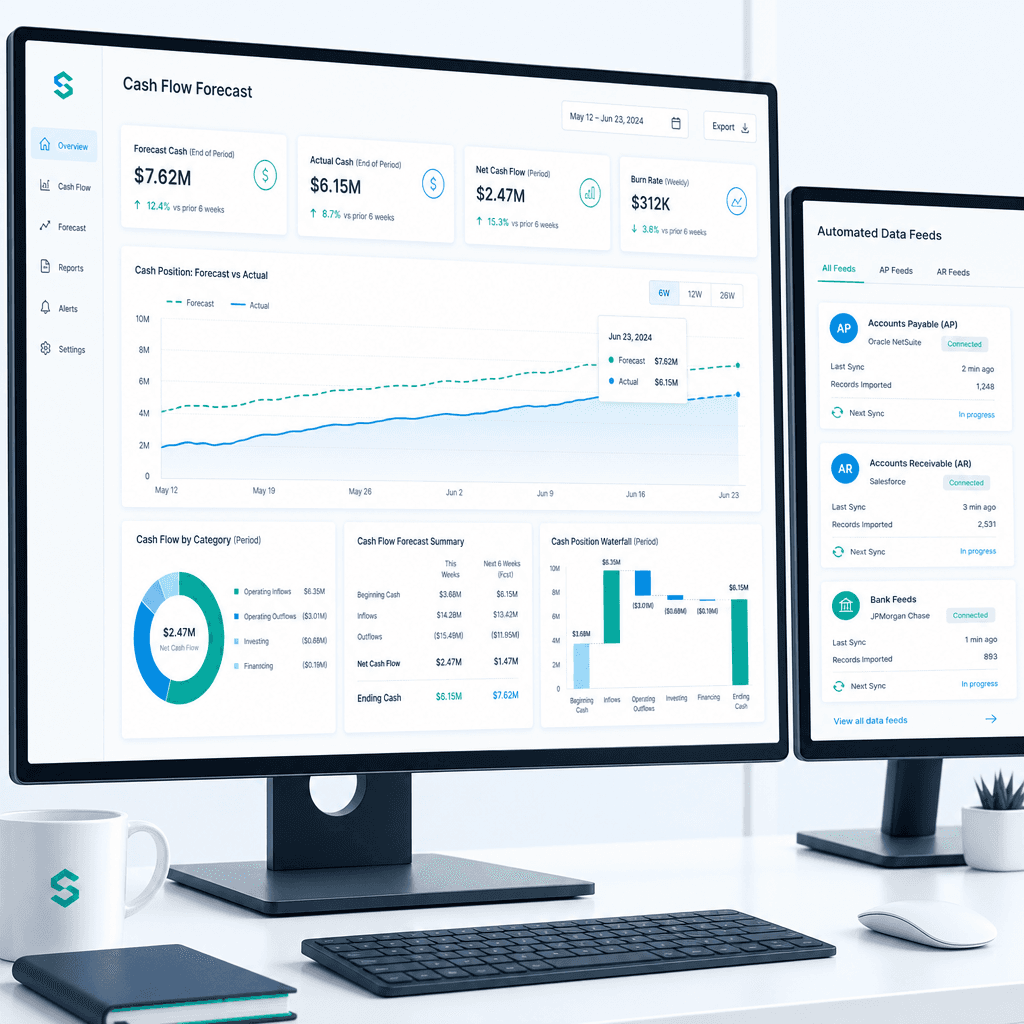
Cash Flow Forecasting Automation: A Practical Guide for Australian Finance Teams (2026)
If your finance team rebuilds the cash flow forecast from scratch every week or every month, you already know where the time goes. Someone pulls an AR ageing…
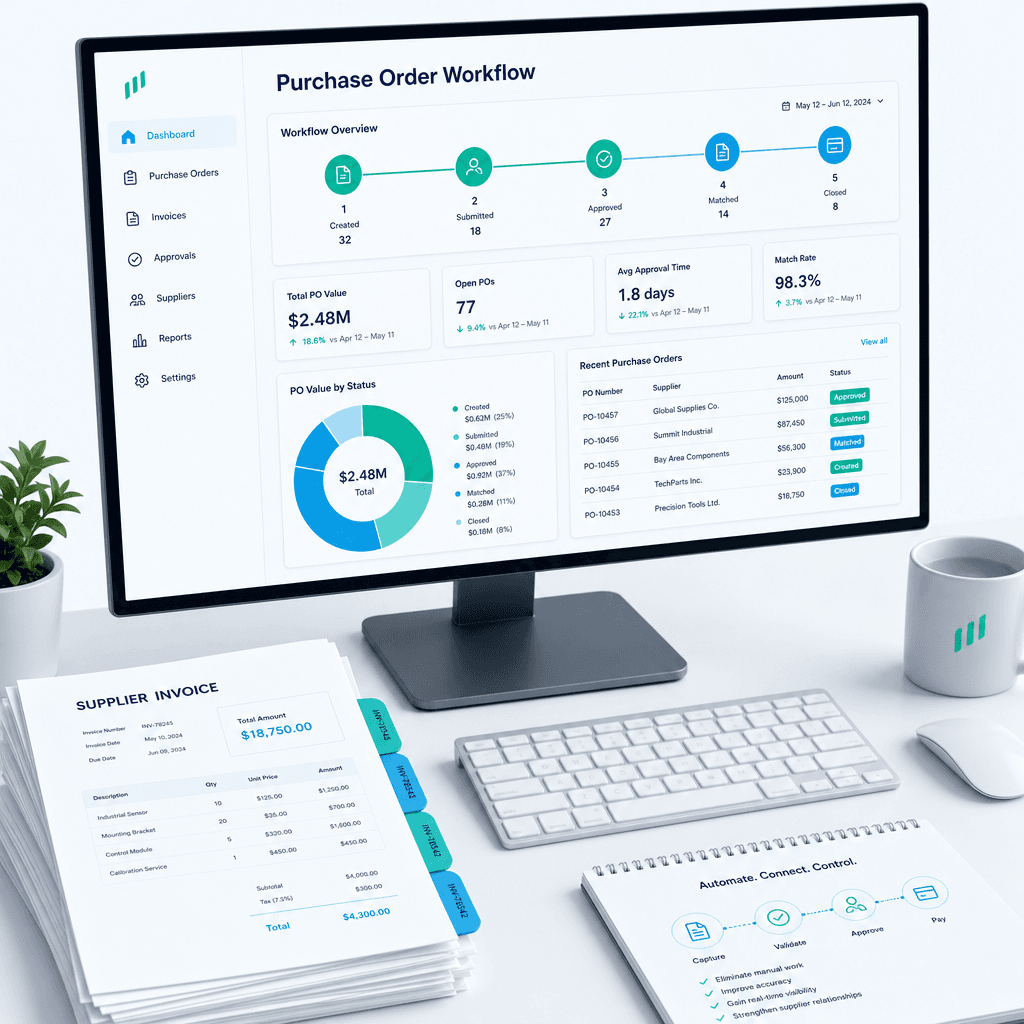
Purchase Order Automation: A Practical Guide for Australian Finance Teams (2026)
If your finance team is still raising purchase orders in a shared inbox, chasing approvals over email, and manually matching invoices line by line before month…